The Happy Wanderers

My wife and I just came back from a week in Chicago. What made the trip extra special was that we traveled with a favorite couple of ours, Leslie and Grant.

I got to know Leslie over 25 years ago when I began taking my students to the Los Angeles Opera.   She was a guest speaker for my English classes as part of the Opera League.  She would drive from Pacific Palisades to Glendale with props to supplement her lectures.  When doing a presentation on Puccini’s “La Boheme” she designed a French café ambience with freshly baked tea cookies and juice for my classes.

Her enthusiasm for sharing her passion for opera with young people was contagious.  In fact, it was because of her that I grew to enjoy opera.  A relationship grew.  My wife and I began socializing with her and Grant, her partner.

Leslie came up with the idea of starting an Opera Club at Hoover High School where I worked.  She’d teach a select number of students after school about operas that we all would see, courtesy of her generosity.  She even treated everyone to dinner beforehand.

After a few years, I stopped taking students to the opera, and soon our connection went dormant. 

The 2019-2020 academic year was my final one as a teacher so I wanted to teach opera again, taking my students to see a new production of “La Boheme” at the Dorothy Chandler Pavilion.  I instantly knew that Leslie had to be part of this experience.

I scoured through my filing cabinets for the opera lesson plans in hopes of finding her phone number—and I did.

Just as she had done years ago, Leslie made the trek from the Westside to Glendale, bringing her materials and cookies for my students.

Since then, my wife and I have enjoyed the company of Leslie and Grant.  Every couple of months we schedule an event and/or a meal together.  We never tire of sharing stories of our lives, often talking for over three hours. 

Earlier this year we discussed taking a week-long trip together to Chicago, a first for our relationship.  From the start we agreed that we would see each other at least once a day, for a meal or an outing, leaving the rest of the time for each couple to be on their own. 

We each created an itinerary, compared notes, then chose the times when we would all be together.

By the way, Leslie and Grant are the most active people we know—world travelers—with an insatiable curiosity to discover something new.

When they travel, they don’t limit their activities to sitting on tour buses.  They take long walks, ride horses and go kayaking, an inspiration for older adults who may put boundaries on what they can do in their golden years. 

It was fun sitting together in the first row of the airplane, Grant and Leslie on the left, my wife and I on the right.  We stayed at the same hotel and often had breakfast together.

Most of the trips my wife and I have taken have been with our sons so this was a refreshing change to travel with another couple.

I’m happy to report that the vacation was memorable. 

Over the course of the week together we discovered that each of us contributed something that enriched the experience.  Grant and Leslie’s enthusiasm for Frank Lloyd Wright inspired us to visit his Robie House in Hyde Park, a tour they themselves took a couple of days earlier.  I suggested attending a magic show that wasn’t on their radar, while my wife showed them how to use an Uber app so they didn’t have to only rely on taxis. 

Besides the magic show, all four of us went to the Green Mill, the oldest jazz club in the Windy City, to hear a band play swing music while semi-professional dancers put on a show. 

We visited Second City where so many famous comedians from the past 50 years got their break. 

We traveled to Oak Park to explore Frank Lloyd Wright’s home and studio he built in 1889, then walked with a docent throughout the preserved neighborhood where houses with beautiful architecture abounded.

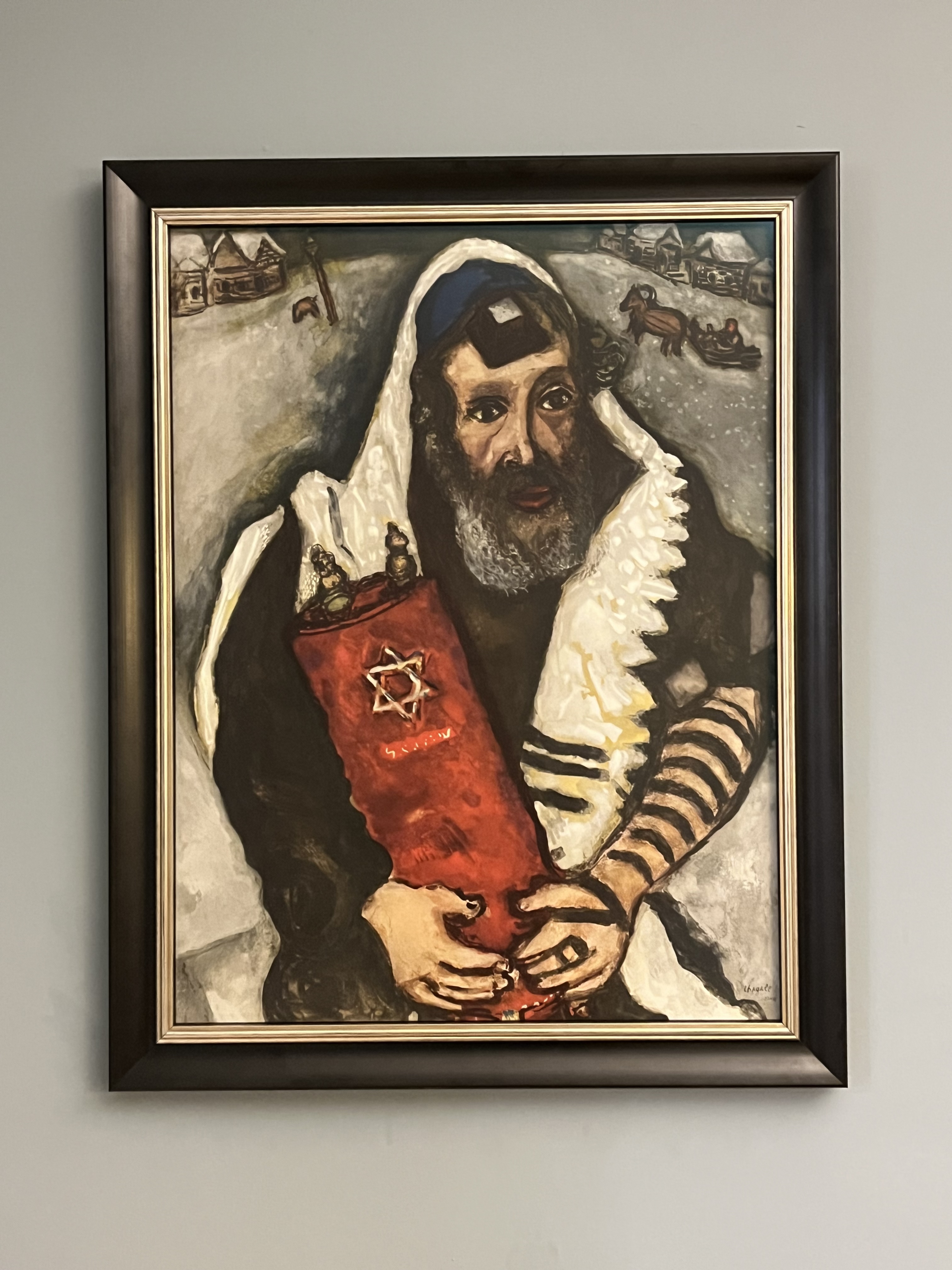
We went to the Art Institute of Chicago to see a special exhibition of Henri Matisse’s “Jazz” book.   Then each couple continued exploring on their own.  One must for me was to put my eyes on Marc Chagall’s “The Praying Jew” painting which preceded his “Rabbi with Torah” work that I wrote about earlier this year that hung in my family’s home when I was a child.

After exploring several gallery rooms and not locating it, I got nervous because some spaces were closed for renovation and I thought how unhappy it would be if it wasn’t on display.   But after getting help from an employee, my wife and I finally found it.  What a mesmerizing work of art.  We sat on a bench so that we could spend more time with it, when suddenly I heard “Brian”—it was Leslie calling my name.   How serendipitous that the four of us reunited in the museum in front of that painting.  Wow.

We look forward to more excursions with Leslie and Grant in the future.  In the 1960s there was a syndicated TV travelogue program called “The Happy Wanderers.”  Next trip, all four of us will be wearing custom-made shirts with that moniker.
Resurrecting a Family Heirloom (Part 2)

Recap from Part 1

I discovered that a long‑cherished family art piece—an old, faded print my mother displayed for decades—is actually a reproduction of Marc Chagall’s “Rabbi with Torah,” a connection deeply tied to her family’s Jewish and Ukrainian heritage. This revelation sparks a quest to restore or replace the artwork, culminating in an unexpected twist when an eagerly purchased replacement is abruptly refunded.

Part 2

I immediately emailed the eBay seller as to why I received a refund after my purchase was confirmed just minutes earlier.  He replied, “I pressed the wrong button. The correct is I’m refunding you.”

You mean this work had already been sold?

“Just to be clear—I am not getting this painting?  It meant so much to me.”

Seller: “I do have quite a few Chagall works so let me show you if you’re interested.”

Wow.  I was beside myself with a mixture of confusion, anger and despair.

Was this an honest mistake by the seller, or a calculated ploy to sell other items he had?

I was so distraught over this news I couldn’t think straight.  My wife encouraged me to just reframe the original and display it. 

But I couldn’t help myself.  I was determined to keep hunting.

By 11:30 a.m., I found one on Etsy.  However, the photo of the item looked digitized and fake. I asked the seller if he would upload actual photos and he did.  Unlike the one I had originally purchased on eBay, this one had visible folds and other imperfections, plus was more expensive than the other.   I hesitated to buy it.

All day Sunday and into Monday I kept checking for any more available copies.  I found an excellent reproduction from an eBay seller who had a physical art store.  As I was on the page, a notification popped up on my screen that this item was in another potential buyer’s shopping cart. 

I panicked.  I had to act fast.  I didn’t want to lose another chance.  I frantically pressed the BUY IT NOW button. 

On Monday, Feb. 2 at 11:49 a.m. I got confirmation of my purchase.  Yes!  But after what happened to me on Saturday, I stifled my enthusiasm.  I had to make sure that the sale was for real this time.

At 7:30 a.m. on Tuesday, I received an email directly from Mark, who works for Meibohm Fine Arts in East Aurora, New York.  Celebrating their 125th anniversary, the granddaughter of the founder runs the family business.  He thanked me for the purchase.  Whew!

He shared with me that “most of the New/Old Stock items in our archive have not seen the light of day in over 75+ years, a rarity indeed, and that this vintage mid-century lithograph has never been framed.”

Mark would mail the litho via UPS later that day, with an expected delivery on the following Monday.  However, this was occurring during the intense cold storm that pummeled much of the country with snow and ice so I had to keep watch over the progress of its movement to notice if there were any delays.

Anxiety came over me as the week wore on without any progress on the UPS tracking website.  I checked it on Wed., Thur., Fri., and Sat., but the needle hadn’t moved from the “dropped off” status.  Steps still to come: “on the way,” “out for delivery” and “delivered.”  

Mark kept checking on it as well, even on his days off.  I wouldn’t be able to contact UPS until Monday so I had to sweat it out that the item was not lost.

In the middle of Sunday, I received a notification from UPS that the lithograph was arriving on Monday after all.  However, the status had not changed.  Which one was correct?

On Monday morning, movement finally occurred on the UPS tracking tool.

9:56 a.m. “on the way”

10:53 am. “out for delivery”

With an expected delivery by 9:00 p.m., that gave me 10 more hours to wait; throughout the day, Mark and I exchanged emails.  Now that’s remarkable customer service!

Sure enough, at 6:11 p.m., “ding-dong.” 

I opened the door to see the UPS man holding on to a long-tubed package.  Finally—relief.  As I signed for it, I gave the driver a 30-second recap of the whole story.

I had my wife videotape me as I opened the tube and gently pulled out the rolled-up lithograph.  Marc did a meticulous job of wrapping it with arrows marked on the tiny pieces of tape guiding me on the correct direction to pull the tape.

When I removed the print out of its protective bubble wrap and unfolded it, I was quite impressed by the pristine condition of something that was manufactured several decades ago.  In the at the bottom in the white margin surrounding the poster was information about it, including the following:

Marc Chagall (1887-    ). 

In other words, when these lithographs were produced by the New York Graphic Society in the 1950’s and 1960’s, Chagall was still alive (he died in 1985).

And there it was, side-by-side with my Mom’s version.  Quite a difference.  If I had any doubt about buying a newer one, it vanished:  this beautiful lithograph was the proper decision. 

With this enhanced reproduction, the details of the work can more clearly be seen.

In the foreground is the rabbi wearing traditional dress appropriate for praying.  He holds a Torah scroll, the most important text in the Jewish religion.  A snow-covered scene of a Russian village emerges in the background (condensed from the Stedelijk Museum’s website).

In the upper left of the painting, there is a pig and a lamppost; in the upper right, there is a horsedrawn sled with an occupant or two.  Behind that are a few straw-roof houses that complete the depiction of a shtetl.

The work symbolizes that Judaism survives even in a bleak world.  And unlike Mom’s poster, Chagall’s signature is clearly visible in the bottom right corner.

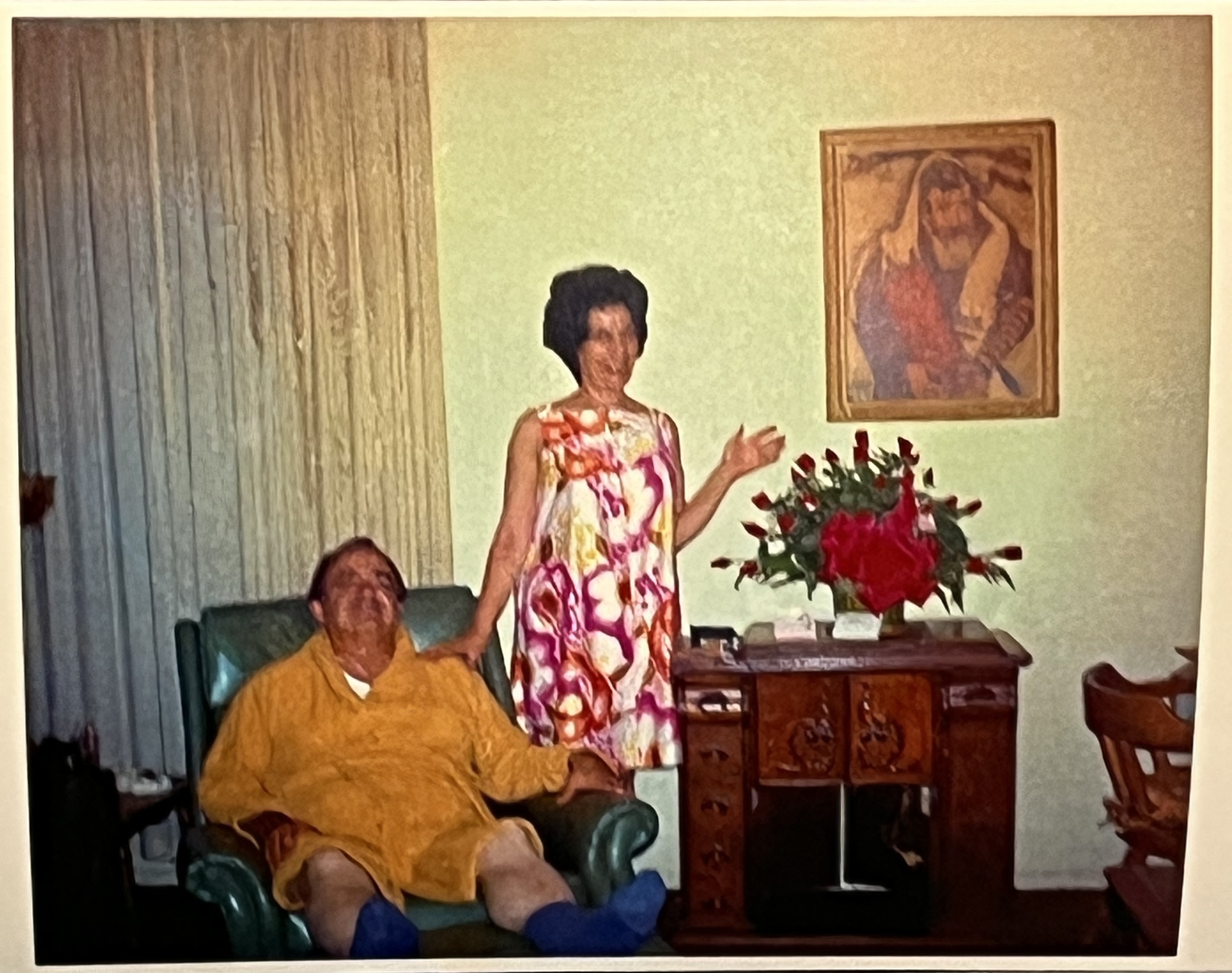
Dad sitting in his recliner he got for Father’s Day and Mom showing off roses she got for their wedding anniversary with the Chagall painting on the wall (left); the new lithograph framed and hung in our dining room (right).

It took two weeks and now it is on display in our dining room.  The rabbi is looking to his left where the opening is to our living room, welcoming visitors who walk through the portal.

My mother would have been impressed to see the full beauty of the work that captured her eye so many decades ago, now protected for generations with museum-quality UV-resistant glass and frame, a fitting, living tribute to her and my maternal grandparents who I never knew.

It makes one think of the serendipity of this adventure.

If not for having watched that “CBS Sunday Morning” show, none of this would have happened.

If not for that eBay seller canceling my purchase, I would not have ended up with a high-quality lithograph from a high-class business as Meibohm Fine Arts.

I wish I could share with Mom everything I’ve learned—but maybe, just maybe, she already knows.

Mourning the loss of The Pantry

We all want to live a long life.  However, if we live long enough, we will end up outliving things that bring us joy such as our favorite restaurants.

Case in point, the Original Pantry Café in downtown Los Angeles which survived over a century before closing last week.

Former Los Angeles Mayor Richard Riordan who died in 2023 loved the restaurant he owned so much that in 1985 he made sure that the air space above the one-story structure (where it moved to in 1950) would be protected from development.

Those managing his trust which benefits several charities want to maximize the wealth of its portfolio by selling the restaurant at the intersection of 9th and Figueroa to generate more revenue.

I will miss the grilled sourdough toast, the overflowing plate of crunchy-on-top potatoes and the bottomless mug of joe.   All of that could be resurrected if a new location could be found, but what will forever be lost will be the physical space which remained unchanged for 75 years as well as the employees, some of whom had decades of experience.

The décor remained constant:  high-back wooden chairs, white Formica tables with condiments, huge menu boards adorning the walls, and the line of people outside, always a line, wrapping down its 9th Street side as if hugging an old friend. 

As everyone patiently waited for one of the waiters to step outside to call the next customer, it was easy talking to strangers in front or in back of you, one of the few downtown places where pleasantries were exchanged; it made everyone feel connected to our common city.

There were two doors guarding the interior:  one for entering and the other for exiting.  In order to leave, the traffic flow led customers to a small enclosure (like an old bank) where the cashier sat on a stool.  Your belly was full and life was good.

That small corner piece of real estate created countless memories for those of us who frequented it as one of the few eateries open 24 hours (until the Pandemic), a beacon for night owls like my friends who would head over there following a 10:00 p.m. movie at the Grauman’s Chinese Theater, or a 4:00 a.m. breakfast after staying up all night.  In either case, it was the perfect L.A. nightcap. 

I was a teenager when I “discovered” The Pantry, always ordering breakfast. When all the other restaurants in the L.A. area were closed, you could always count on getting something good to eat at the Pantry and feel blanketed by its history.  

When I last went to The Pantry months ago it was celebrating its centennial.  I purchased a new Pantry mug since the logo on my one at home had long ago vanished.  Now that the Pantry has vanished, I cling to the new mug I have, a reminder of good times.

Angelenos are familiar with the heartbreak of iconic restaurant closures, most notably the Pacific Dining Car (1921-2020).  We still have century-old establishments such as Cole’s (1908), Philippe’s (1908), Musso and Frank’s (1919), Tam O’Shanter (1922), and El Cholo (1923). That’s why it behooves us all to keep returning to them while they remain.

When a business lasts for over 100 years in Los Angeles it is a miracle.  And now we have one less miracle in our lives.

The Pantry was THE diner of Los Angeles, a “welcome to L.A.” ambassador that lasted through 17 U.S. Presidents.  It nourished us not only with comfort food, but history of the city.  People need places like these to nourish one’s soul.  Like a friend who passes away, it’s painful knowing that you can never go back to it again.