Get Ready for Less Qualified Teachers

This year, over 17,000 teaching credentials will be issued in California, not enough to fill about 25,000 vacancies.  In order to encourage more people to go into teaching, a new state law was passed in 2024 allowing anyone with a bachelor’s degree to get accepted into a teacher credential program.   It is no longer necessary to pass a test to assess a candidate’s basic knowledge of reading, writing and arithmetic.  It is no longer necessary to have a minimum 3.0 GPA.

California Commission on Teacher Credentialing’s Executive Director Mary Vixie Sandy said that “now is a great time for anyone with a qualifying bachelor’s degree” to become a teacher.

Why is allowing less qualified people into the profession viewed as a good thing?

Instead of fixing what ails the teaching profession, namely a lack of prestige, competitive salaries and support from administration and parents, the state is lowering the qualifications to attract more people into the classroom.  If anything, higher minimum requirements is the first step in ensuring only qualified people be allowed to teach.

If this approach were applied to the medical field, with an influx of doctors who could not otherwise meet basic requirements suddenly earning medical degrees, they’d be an uproar about health care.

For some reason, when it comes to education, there isn’t any pushback that more inexperienced, less academic people will be teaching young people.  But it gets worse.

To meet the demands of the teacher shortage, school districts are hiring people on an emergency credential that pays them a full salary without taking the two years of coursework and student teaching that traditional candidates complete.

Even those teachers who do the full credential coursework and earn a credential aren’t destined to be effective teachers.

I know this first-hand from my work as a university field supervisor who visits schools where the teachers in training work.  My job is to observe a candidate teach between three to six lessons over an 18-week semester, then evaluate their strengths and weaknesses.

More important than someone like me is the mentor teacher who observes the teacher candidate every day, reviewing their lessons and offering suggestions.   It’s crucial that the mentors are highly qualified.  Unfortunately, many are not. 

College credential programs don’t have the luxury of vetting mentors due to how few classroom teachers show interest in that role.   That’s because not enough excellent teachers are willing to hand over a couple of their classes to a novice.  Often, those who become mentors are those who are looking for a lighter workload.

That’s why the evaluation forms from the mentors may not be an accurate assessment of a student teacher’s abilities.  After all, how can an ineffective teacher help a young teacher be effective? 

I often find myself assigning higher marks for candidates based on the inflated evaluation of the mentors.  It is difficult for someone like me to hold higher standards since the mentor is seeing so much more of the candidate.  How can I justify lower marks when I’m only observing six lessons, while the mentor observes 90 lessons?

My job observing student teachers for the past four years is frequently disappointing and sometimes depressing.  Still, each semester I meet that one young teacher who has a knack for working with kids, a desire to help children with their academics and their lives.  That’s what keeps me going, a flame of faith that for some students, their future will be bright.

Sibling Love

Throughout my 67 years of life, I have shared my entire existence with only two individuals: my brother, Greg, and my sister, Debra.  The three of us have indelible positive memories of growing up together, and that glue hasn’t dried up.   As each of us have left home and gotten married, starting our own families, we continued seeing each other to celebrate birthdays and holidays together as the original Crosbys, a bond unbroken, transcending any differences in politics or lifestyle.

We weathered losing our father at the age of 60 in 1973, when we were 24, 20, and 14.  When we lost our mother at age 82 in 2006, it was a wake-up call that our generation would be next in line to pass away.

We were fortunate to live almost two decades before another funeral.  Sadly, a few weeks ago, Greg’s wife, Jane, passed away.  They were married for 47 years.  Losing a spouse is a deeper loss than losing one’s parents because it is one’s life partner.  People live with their parents for on average of 20 years, but marriages can last more than double that length. 

When people find out how long a couple is married, it is applauded:  25, 30, 50 years.  Yet the longer a person is with their partner, the harder it is to live without that companion. My brother was blessed to have 47 years with his wife, nearly twice as many as our parents had.  The longer the marriage, the deeper the loss.

For my sister and I it is difficult watching our brother grieve, a life experience neither one of us has had.   I already have friends who have lost a sibling so we’re lucky that the three of us are still around.  But when the time comes for one of us to leave, it will be yet another unpleasant loss. 

I’ve often thought that when a person close to us passes away, in an odd way, their passing is a gift to us:  a reminder of how precious life is.  With each passing, there is increased urgency so make the most of the remainder of one’s years.  And it is the duty of the living to keep alive the memory of those who meant so much to us.

Mourning the loss of The Pantry

We all want to live a long life.  However, if we live long enough, we will end up outliving things that bring us joy such as our favorite restaurants.

Case in point, the Original Pantry Café in downtown Los Angeles which survived over a century before closing last week.

Former Los Angeles Mayor Richard Riordan who died in 2023 loved the restaurant he owned so much that in 1985 he made sure that the air space above the one-story structure (where it moved to in 1950) would be protected from development.

Those managing his trust which benefits several charities want to maximize the wealth of its portfolio by selling the restaurant at the intersection of 9th and Figueroa to generate more revenue.

I will miss the grilled sourdough toast, the overflowing plate of crunchy-on-top potatoes and the bottomless mug of joe.   All of that could be resurrected if a new location could be found, but what will forever be lost will be the physical space which remained unchanged for 75 years as well as the employees, some of whom had decades of experience.

The décor remained constant:  high-back wooden chairs, white Formica tables with condiments, huge menu boards adorning the walls, and the line of people outside, always a line, wrapping down its 9th Street side as if hugging an old friend. 

As everyone patiently waited for one of the waiters to step outside to call the next customer, it was easy talking to strangers in front or in back of you, one of the few downtown places where pleasantries were exchanged; it made everyone feel connected to our common city.

There were two doors guarding the interior:  one for entering and the other for exiting.  In order to leave, the traffic flow led customers to a small enclosure (like an old bank) where the cashier sat on a stool.  Your belly was full and life was good.

That small corner piece of real estate created countless memories for those of us who frequented it as one of the few eateries open 24 hours (until the Pandemic), a beacon for night owls like my friends who would head over there following a 10:00 p.m. movie at the Grauman’s Chinese Theater, or a 4:00 a.m. breakfast after staying up all night.  In either case, it was the perfect L.A. nightcap. 

I was a teenager when I “discovered” The Pantry, always ordering breakfast. When all the other restaurants in the L.A. area were closed, you could always count on getting something good to eat at the Pantry and feel blanketed by its history.  

When I last went to The Pantry months ago it was celebrating its centennial.  I purchased a new Pantry mug since the logo on my one at home had long ago vanished.  Now that the Pantry has vanished, I cling to the new mug I have, a reminder of good times.

Angelenos are familiar with the heartbreak of iconic restaurant closures, most notably the Pacific Dining Car (1921-2020).  We still have century-old establishments such as Cole’s (1908), Philippe’s (1908), Musso and Frank’s (1919), Tam O’Shanter (1922), and El Cholo (1923). That’s why it behooves us all to keep returning to them while they remain.

When a business lasts for over 100 years in Los Angeles it is a miracle.  And now we have one less miracle in our lives.

The Pantry was THE diner of Los Angeles, a “welcome to L.A.” ambassador that lasted through 17 U.S. Presidents.  It nourished us not only with comfort food, but history of the city.  People need places like these to nourish one’s soul.  Like a friend who passes away, it’s painful knowing that you can never go back to it again.

Average is Not Good Enough For Kids

News alert:  The people entering the teaching profession are less proficient than their older counterparts and they are the ones that carry the mantle of education America’s youth.

In education, there are two checkpoints during a new teacher’s journey towards earning a teaching license:  entering a university credential program and passing a year of student teaching.

If during this process either of these two checkpoints fail to weed out weak candidates, credentials will be handed out, a golden ticket to gaining lifetime employment in a school.

That’s why it is essential that the requirements remain high to ensure that children receive a quality education.

The California State University system is the largest of its kind in issuing teaching credentials.  Part of the requirements used to determine eligibility for a credential program is a college student’s grade point average or GPA.  The long-standing benchmark used to be a minimum 3.0 or ‘B’ average.  In recent years, however, 16 of the 22 CSU campuses have lowered the GPA:  six use 2.75 or 2.67 (B-), eight use 2.5 (C+) and one uses a 2.0 (C).

Evidently, not enough smart people are choosing teaching as a career so somehow the credential-issuing mechanisms have to come up with ways to allow subpar people to fill classroom positions.   It’s a paradox that those who don’t excel at academic achievement choose a job that requires teaching young people to excel academically.

Once weaker candidates gain entrance into the program, the final step is to teach a few classes in a real classroom with a mentor teacher present.  If the candidates earn passing scores on evaluation forms, they walk away with a license to teach.

Sadly, some that accept the role of mentor are not the best in the business.  Often a school-wide email goes out asking for volunteers.  While some effective teachers willingly sign up, too many other ineffective ones look at mentoring as a way to lessen their workload.  Instead, universities should be aggressively recruiting high quality mentors which means paying them more than $150 per semester.

The evaluation forms themselves are problematic.  A candidate is evaluated based on dozens of teacher behaviors using a three-point scale:  exceeds, meets or below standards.  As long as a student teacher has no more than five “below” standards, that candidate receives a credential.  Shouldn’t that candidate earn five “above” standards to even the score?

Think about the uproar if in the medical field, surgeons who barely passed were those who instructed interns on the finer details of surgery.

In addition to the mentor teacher’s evaluation, universities use former teachers and administrators to observe and evaluate as well.  However, these field supervisors only watch a handful of lessons compared to the nearly 90 viewed by the mentor teacher.  That is why it’s critical to ensure that mentor teachers are the best in the business:  they are the last bulwark against ineffective teachers populating classrooms.

Los Angeles on Fire

When I dropped off my laptop at the Apple Store to be repaired on Jan. 6, the outlook was gloomy knowing I wouldn’t have a computer for at least a week.

My self-pity vanished quickly the next day when Santa Ana winds gusting at hurricane speeds up to 100 mph whipped across the Los Angeles basin, the strongest I’ve ever remembered in my lifetime.

First, a huge avocado branch from our neighbor’s yard broke off and blocked our driveway.  After 30, I lost track of how many avocados I picked up.  Damn that wind.

Later that day, a fire broke out in the Pacific Palisades.  I turned on local news to discover this wasn’t just any conflagration that only threatened homes—it was disintegrating them into ashes.

By the end of the day, another fire broke out in Altadena, named the Eaton fire.  Evacuation alerts shook people’s smart phones.  Firefighters futilely fought the wind-swept flames as they devoured blocks of houses.  Usually, a neighborhood wiped out by fire occurred in remote, mountainous areas.  Never have I seen such destruction in highly populated areas.

Every local news channel had 24-hour coverage without commercials.  Just as firefighters from around the country, and even from Mexico, flew into L.A. to battle the blazes, reporters out of state were arriving into town to cover the widespread destruction.

Wednesday morning, the sunrise looked apocalyptic, the sky nearly dark with enormous smoke clouds mimicking an eclipse.  This was no ordinary event.

In the next couple of days, four more smaller fires would break out.  I felt for those who had to evacuate and those who lost all of their homes and possessions.  This tragedy touched us more because we also live in a hillside region. 

Back in 2017, the ridge not far from our house was on fire.  If we were one block closer to the mountains we would have had to evacuate.  However, that fire was contained before it swept down the ridge.  This tragedy was a wake-up call that such destruction could happen to us.

For the next two weeks, Los Angeles made international headlines.  On all media platforms, one could not escape images of burning homes and people weeping.  With thousands of structures destroyed, drone cameras showed land that looked as if a bomb had hit it.

Wherever we went, no matter who we encountered—a neighbor, a server at a restaurant, a person in line at a store—we felt compelled to “check in” on them:  are they okay?  Everyone knew someone who had been evacuated and who had lost their home.  All Angelenos felt terrible that their city was hurting. 

Our hearts go out to those who are homeless and now have to figure out a path of recovery.  This natural disaster most likely will become the worst in U.S. history in terms of financial cost.  Miraculously, only a couple of dozen people lost their lives.  About 8,000 people died in the Great Galveston storm of 1900.

The one bright light among the devastation were the countless volunteers who have donated goods and who have helped shelter those in need, including pets.  Oddly, tragedies bring out the best in people.  A reminder that through the thicket of noise about how divided people are about politics rises the common humanity that binds us as a people.

“Night of the Meek”–a Christmas gift

During December, I enjoy re-watching old Christmas movies and TV shows because there is an emotional tether to my childhood. 

One of my favorite is The Twilight Zone’s “Night of the Meek,” the only Christmas episode of the series.  Starring Art Carney of The Honeymooners fame as an alcoholic department store Santa Claus, this was one of only a handful of episodes shot on videotape, so though it is in black and white, it doesn’t look six decades old; it has a “live” feel to it.  The black and white cinematography and minimal sets adds realism.

But it is Carney’s conviction in the role as a troubled man who wants to do good for impoverished people that elevates the drama.  The children and elderly men in bit parts come across as authentic.

Some of Serling’s lines that Carney delivers carry weight to the show’s theme of neglected children and the elderly.

After getting fired by his employer, he says the following speech.

“Christmas is more than barging down department store aisles and pushing people out of the way.  Christmas is another thing, finer than that, richer, finer, truer.  It should come with patience, and love, charity, compassion. . . . I live in a dirty rooming house and the street filled with hungry kids and shabby people where the only thing that comes down the chimney on Christmas Eve is more poverty.

“I just wish that on one Christmas, only one, that I could see some of the hopeless ones and the dreamless ones.  Just on one Christmas, I’d like to see the meek inherent the earth.  That’s why I drink, and that’s why I weep.”

This was powerful language for 1960 television. As he speaks, director Jack Smight intercuts close-ups of the children intently listening, including one Black boy, a rare casting decision at the time.

After departing the department store, Carney comes across a bag of gifts down an alleyway.  He throws the bag over his shoulder and approaches children on the street and homeless men inside a Salvation Army chapel, asking each one what would they like for Christmas.  Magically, he pulls out the very item requested from the bag.

At the end of the story, Carney has no more gifts.  A friend observes that he didn’t get a gift himself.

“I can’t think of anything I want.  What I really wanted is to be the biggest gift giver of all time. . . If I had my choice of any gift, any gift at all, I’d think I’d wish I could do this every year.”

Serling’s narration at the end:

“A word to the wise to all the children of the 20th century, whether their concern be pediatrics or geriatrics, whether they crawl on hands and knees and wear diapers or walk with a cane and comb their beards.  There’s a wondrous magic to Christmas, and there’s a special power reserved for little people.  In short, there’s nothing mightier than the meek, and a merry Christmas to each and all.”

It’s remarkable that this 25-minute show, shot over the course of a few days, withstands the test of time and can bring a tear 64 years later.

By the way, this episode was remade for the 1985 reboot of The Twilight Zone.  Though 25 years separate the two versions, the 1960 original has more heart and actually does not look dated compared to the newer one.

What makes this show personal to me is that Serling, despite being Jewish like myself, wrote such a touching tale about the humanity of Christmas. I grew up loving a secular Christmas, believing in Santa Claus, and enjoying Christmas shows and music, many of which were created by Jewish artists.

P.S.  Rod Serling was born on Christmas day, as was my father.  Serling was only 50 when he died in 1975.  He would have been 100 years old this Dec. 25th.

Art Carney as Santa Claus.

Writer Rod Serling, creator of The Twilight Zone.

Memories by John Williams

As a teenager, the section of any record store where I spent the majority of time browsing was the film soundtracks.  Most of my albums were scores by my favorite composers:  Bernard Herrman, Jerry Goldsmith, Danny Elfman, and John Williams.

At that time, one could not see a film again unless it was shown on television or re-released in movie theaters.  So, I’d play an album on my record player and allow the music to wash over me as I reclined on my bed staring up at the blank ceiling, letting the musical leitmotivs conjure up specific scenes from the film.

This month, a new documentary premiered, “Music by John Williams,” chronicling the maestro’s life story.  Its subtitle could be “With Collaboration by Steven Spielberg” because in nearly all of his 34 films, the film director has worked with Williams.

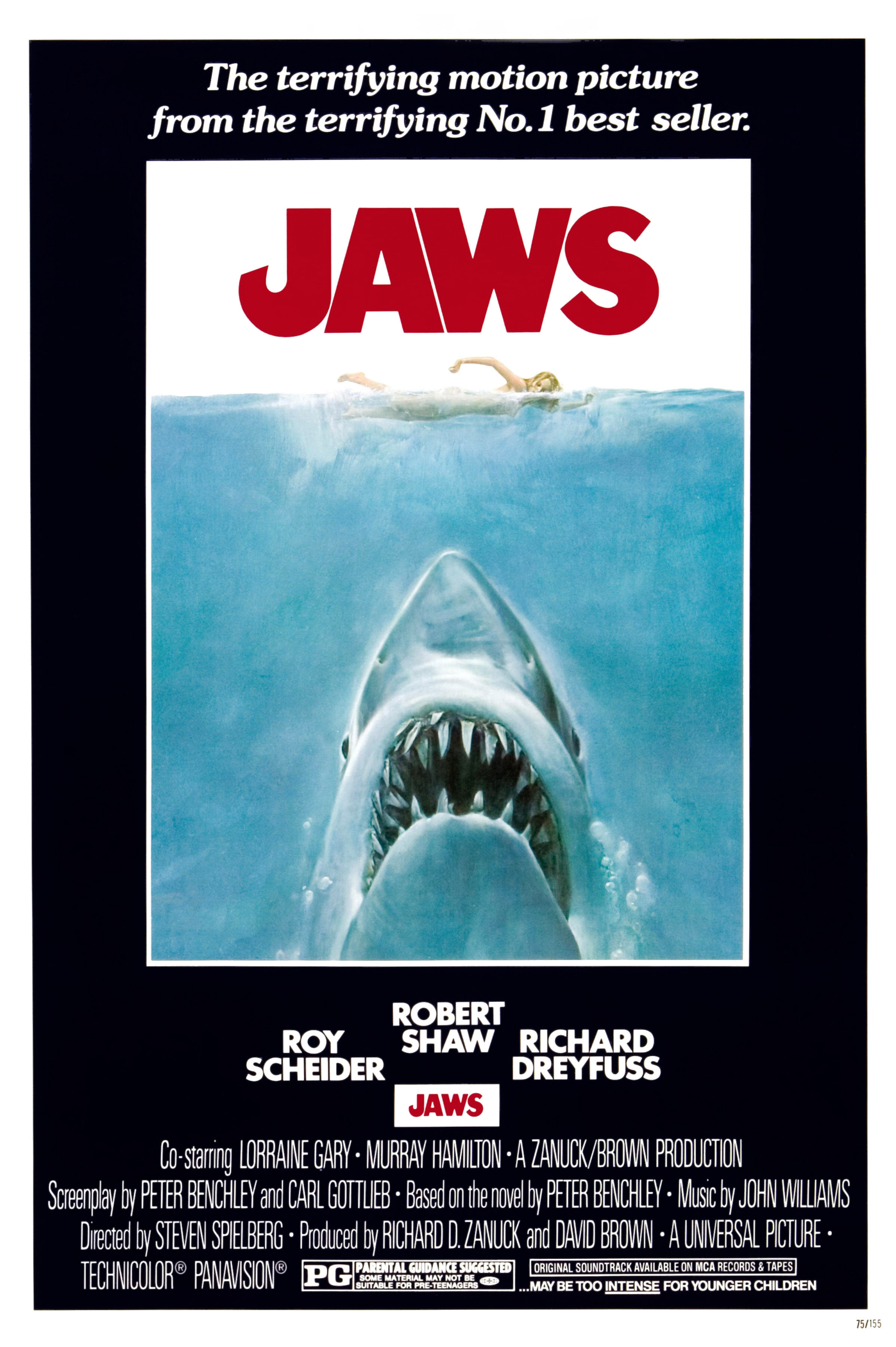
It is an unprecedented nearly half a century of work that began in 1975 with “Jaws” and was last renewed in 2022 with “The Fabelmans.”  When they first worked together, Spielberg was 29 and Williams 43.

During this second half of his life, Williams found a second career as a conductor, first as the principal conductor with the Boston Pops Orchestra for 14 years, then as a guest conductor with orchestras around the world (he’ll head the Berlin Philharmonic in June 2025).

Try to imagine any of these movies without hearing in your head their musical themes:  “Jaws,” “Star Wars,” “Close Encounters of the Third Kind,” “Superman,” “Raiders of the Lost Ark,” “E.T.,” “Jurassic Park,” “Schindler’s List,” or “Harry Potter and the Sorcerer’s Stone.”

Every time a person sees a film released by Universal, one also hears the fanfare music by Williams.  That goes for the Olympics and NBC News.  And to think he began this body of work in his mid-40’s.  Little did he know his life was only at its mid-point.

His most stirring pieces can rouse one’s spirits:  Superman flying through the sky, the Jedi fighters diving deep into the Death Star, Indiana Jones dashing away from danger onto a plane, the boys’ bicycling across the moon.  His most quiet passages can bring tears:  Elliot saying goodbye to E.T., Schindler at a loss upon receiving a gold watch from the Jewish people whose lives he saved.

Despite technological advances in devices that could write the notes for him on a scoresheet, he adheres to his laborious habit of writing down each note by hand.  And, with few exceptions, chooses not to employ electronic instruments because, as he says, you can’t hear a musician’s soul through a synthesizer.

Of course, there are scores of films Williams worked on that aren’t memorable.  There are critics who view his work as derivative and schmaltzy.  But there’s no denying that some of his compositions will never be forgotten.

John Williams and Steven Spielberg.

America’s Split Personality

An avalanche of political discourse has spilled over the media pipeline the past couple of weeks in a futile effort to explain the results of this year’s presidential election.  For those who voted for Harris, it is a fruitless search for answers.

I’ve read op-eds, watched YouTube videos and heard podcasts where political pundits offer their version of why Trump won and Harris lost.

In my common-sense view, I’ve concluded I don’t know and neither does anyone else no matter how much data they pour over.

For me, I view the election results through a bare bones lens.  America had a choice for president:  one was a convicted felon and one was not.

And America chose the felon.

No matter why or how Donald Trump appeals to the public, whether they like his policies or his non-political correctness in his language, his actions on Jan. 6, 2021 of inciting a riot on the U.S. Capitol after two months of denying the election results and not working towards a smooth transition of power to his successor is more than enough evidence to be disqualified for running for president.   Yet for nearly half of all Americans, Jan. 6 meant nothing.

That fact is hard to wrap my mind around.  It’s like living in a society where half of the people feel it’s okay to drive recklessly (oh, wait a minute, we are already living in that society).

For Harris voters, the frustration of her loss is based on perception.  For months, pollsters concluded that the race was too close to call.  Most people ignored the fine print attached to every poll:  a margin of error of a few points.  Therefore, the polls for the most part were accurate.  In the popular vote as of this writing, Trump has 49.9% and Harris has 48.2%, with 2,600,000 votes separating them.  That’s close.  What is not close is the electoral vote which gives the wrong impression that the race was a mandate:  Trump collected 312 electoral votes to Harris’s 226 (270 is needed).  You can’t compare those two numbers mathematically.

The presidential contest has historically been close.  Five of the past nine presidential contests have resulted in the winner not reaching 50%; in other words, a plurality not a majority of Americans voted for the actual president.

“We live in divisive times” is a proclamation that permeates airwaves, as if the times we live in are unique, yet when it comes to raw votes, about half the country chooses a Democrat and the other half chooses a Republican for most of the United States’ history.  The electoral votes exaggerate the 50-50 splits.

Rarely does any president receive more than 60 percent of the popular vote.  John Quincy Adams was elected in 1824 with only 30.9% of the votes.  Imagine him trying to declare a mandate.  Can you guess which president had the second lowest popular vote?  Abraham Lincoln at 39.9% in 1860, often cited as the greatest American president.  More recently, Bill Clinton won with only 42% of the popular vote in 1992.

Only four presidents have ever received 60% or more of the popular vote:  Lyndon Johnson  61.1% (1964), Richard Nixon 60.7% (1972), Warren G. Harding 60.3% (1920), and Franklin D. Roosevelt 60.2% (1936).

American voters since the beginning have divergent views of who should lead our nation.  And when who we want loses, we wonder, “What the hell is wrong with the half the country?”  Instead of getting overly anxious, realize that such angst is part of our tradition.   America takes pride in its diversity in religion and ethnicity so it makes sense that we all don’t vote for the same winner.  That is what makes America great.  And the fact that every four years we get to reset all over again.

Blue Heaven

Sports is a diversion and this year with the exhausting presidential political season, boy, do we all need a diversion.

I was born in the same year when the Brooklyn Dodgers moved to Los Angeles in 1958.  Maybe that connection is why they have always been my favorite sports team.

This week, the Dodgers won their 8th World Series championship against the New York Yankees in five games.

I was too young to appreciate the marvels of the 1959, 1963 and 1965 teams, but I vividly recall the 1981, 1988 and 2020 teams.

This year’s edition may be the most inspiring.   After suffering the most pitching injuries of any other team and losing all-stars Mookie Betts and Max Muncy for months, the Dodgers still managed to have the best record in baseball.  Yet when the playoffs began, they were not expected to win the World Series; they were perceived as the underdogs.

The fact that unlike recent years they had to play meaningful baseball up until the final days of the season to secure a division title kept them on their toes.  There was no time to let up on the gas pedal with the San Diego Padres breathing down their necks (end of the cliches).

At the start of the season, the Dodgers were this year’s overdogs.  With over $1 billion of new contracts last winter, the bulk of that owed to Shohei Ohtani, perhaps the greatest baseball player of all time due to his high achievement as both a batter and a pitcher, the Dodgers were expected to win the World Series before the very first “play ball.”

However, their five-man starting pitching rotation in March was decimated come September.  Only Yoshinobu Yamamoto, the second huge acquisition after Ohtani’s, survived the 162-game season though he missed half of it due to injury; the remaining four starters were lost to season-ending injuries. 

At the mid-summer trade deadline, they signed right-hander Jack Flaherty.  Former ace Walker Buehler took two years to recover from his second Tommy John surgery and pitched poorly throughout this season.  No one gave him a chance of making it onto the postseason roster, but the Dodgers had no one else.

This gave them only three starting pitchers going into the playoffs whereas all the other teams had at least four.  What got them through the injuries was their bullpen, the highest performing of any other team.  

The role of relief pitchers has increased significantly.  In 2024, pitchers threw 26 complete games, an all-time low.  Back in 1975, Oakland A’s pitcher Catfish Hunter threw 30 complete games on his own.  Nowadays, if a pitcher completes six out of the nine innings and allows three or less runs, it is labeled a “quality start.” 

For the Dodgers, their starters barely reached five innings over the course of the season meaning the relief pitchers pitched nearly half of the total innings played.  And that trend increased during the playoffs.  In fact, due to the lack of a fourth starter, they scheduled bullpen games where up to eight pitchers were used to complete one game.   That should not be sustainable, but somehow the Dodgers rode that strategy all the way to a championship.  The Most Valuable Player award should have gone to the entire bullpen.

As the Dodgers ascended each step on their climb up to the title—winning the division, beating the Padres in the division series and the New York Mets in the championship series—their clubhouse celebrations were revelatory.  Their raw comments to reporters unmasked a gutsiness and a love for one another, an intense bonding not seen in recent memory.  Chemistry alone can’t count for success, but matched with each athlete playing for each other, lifting their teammates to another level, it made them unbeatable.

One refreshing aspect to the Dodgers’ championship is that for a change the team with the best regular season in baseball won it all.  In the past 29 seasons, the team with the best record won the World Series only eight times.

Up until 1968, baseball had two leagues:  American and National.  The first-place team in each league faced off in the World Series.

From 1969-1993, a second playoff round was added by dividing each league into two divisions, west and east, which doubled the number of teams eligible for the postseason.

From 1994-2011, a third round (division series) was added by rearranging some teams into a third central division and adding a wild card team from each league resulting in eight teams making it to the postseason.  No longer did a team have to win four postseason games; now it’s 11.

Today, more wild cards teams have been added with 12 out of the 30 teams go into the postseason.  That is why in one respect this year’s Dodgers may very well be the best team they have ever had.  And that’s why if you are a Dodger fan, you should still be grinning.  And if you a sports fan, you should feel validated that once in a while, a sports team that is the best during the regular season does win the trophy.

Seeing these high paid athletes get choked up over a game with a small ball and a long bat, their emotions catching in their throats, underscores that money isn’t everything.  Sports reminds us that joy can be found in myriad ways.  It’s up to each person to go find it.

The Dodgers’ championship is my antidote to whoever wins the election.

Odd Age vs. Old Age

I’m looking forward to this Halloween for it is the one day a year I can hide my head behind a disguise without appearing to be a criminal.

I never considered myself a vain person, but now I’m facing a crisis of confidence being in public.

I’ve reached a time in my life when I shudder seeing my face in a mirror.  One of the off-putting side effects of going on a vacation and staying in hotels is viewing yourself in brightly lighted mirrors (unlike the dimly lit ones at home) that showcase your age.  It is a startling revelation to see:

  • the wrinkles that suddenly appear around one’s eyes and mouth.
  • the graying tone of one’s skin.
  • the lack of hair on one’s head.

For me, I have had a receding hairline for a while now.  But in more recent years, my hair is not just disappearing—it’s practically gone. 

It brings to mind Sylvia Plath’s poem “Mirror” that personifies a mirror commenting factually on what it sees peering into it—an old woman.

“I am silver and exact. I have no preconceptions.
Whatever I see I swallow immediately
Just as it is, unmisted by love or dislike.
I am not cruel, only truthful‚
The eye of a little god, four-cornered.
Most of the time I meditate on the opposite wall.
It is pink, with speckles. I have looked at it so long
I think it is part of my heart. But it flickers.
Faces and darkness separate us over and over.

Now I am a lake. A woman bends over me,
Searching my reaches for what she really is.
Then she turns to those liars, the candles or the moon.
I see her back, and reflect it faithfully.
She rewards me with tears and an agitation of hands.
I am important to her. She comes and goes.
Each morning it is her face that replaces the darkness.
In me she has drowned a young girl, and in me an old woman
Rises toward her day after day, like a terrible fish.”

And that is how I feel.  I no longer recognize the old man who stares back at me.  I see a drooping face of sallow flesh, resulting in a perpetual frown.

Not even my hazel eyes can light up this reflection.  It is a “cold water splashed on one’s face” moment that I cannot escape.

I look older, much older than I feel.  And it troubles me for no matter how energetic I may feel, my face betrays my passions for those who come across me.

For the first time I’m contemplating options that I have resisted.

  • Dying one’s hair.  The number one problem with this route is that I simply have wisps left on top of my much too much visible scalp.  I’d in essence be coloring my skin reddish brown, not my gray straws.
  • Growing facial hair.  It’s a way of re-directing others’ eyesight from the top of one’s head to the bottom though some may question the quality of one’s handlebar mustache, soul patch or Santa beard.
  • Rogaine.  My hair is so thin now that even if new follicles grew, it wouldn’t be enough.
  • Wearing a toupee.  How do I put a wig on my head and act like nothing’s different about me to those who know me?

The quickest solution I’ve come up with is wearing hats.  It’s relatively inexpensive, has nothing to do with chemicals and is instantaneously a complete cover-up on the grotesquerie on my head.  And I could wear a hat all year long without calling attention to myself.  Except it makes me look dorky.  But at this point, I’d rather appear odd than old.