“The Christmas Song” – A Holiday Chestnut

How “The Christmas Song (Chestnuts Roasting on an Open Fire)” originated sounds like a piece of fiction.  A songwriter uncomfortable in the hot summer of Los Angeles decides to write a song about cold things as a way to cool off.  

Yet that is exactly what inspired Bob Wells in 1945 when collaborator Mel Tormé (whose original last name was Torma born of Russian-Jewish immigrants) arrived at his parents’ home in Toluca Lake, an upscale celebrity-inhabited community a short distance from downtown L.A.

When Tormé entered the house, he discovered a 25-word poem (curiously the same number of calendar days leading up to Christmas’s December date) on a writing pad which what turned out to be the opening lines to the song:

Chestnuts roasting on an open fire

            Jack Frost nipping at your nose

            Yuletide carols being sung by a choir

            And folks dressed up like Eskimos

Mel Tormé continues the story in his autobiography It Wasn’t All Velvet:

I took another look at his handiwork.  “You know,” I said, “this just might make a song.”

We sat down together at the piano, and improbably though it may sound, “The Christmas Song” was completed about forty-five minutes later. 

It wasn’t as quickly recorded though, taking a year before Nat King Cole sang it.

It’s funny how both “White Christmas” and “The Christmas Song” are linked to warm weather in Los Angeles.   In Berlin’s verse he talks about palm trees swaying in L.A., and for Wells, it was a 100-degree July day that prompted him to dream of the winter with all its Christmas trappings.

Like a top ten list, the marvel of the song is how it encapsulates so many of the marvelous images and memories people envision about the holiday. 

This classic begins with vivid descriptions of what Christmas is all about:  “chestnuts roasting on an open fire”—burning wood in the fireplace, “Jack Frost nipping on your nose”—cold weather, “yuletide carols being sung by a choir”—angelic Christmas music, and “folks dressed up like Eskimos”—warm winter clothing.  Throw in a turkey, mistletoe, Santa, toys, flying reindeer, and the words “Merry Christmas” and the result is an amazing array of big ideas in a small number of lines that strike an emotional core.

Cole recorded the song four times, the first two recordings occurring within two months of one another. 

In 1946, Nat King Cole was known primarily as a jazz pianist as part of the King Cole Trio.   While he did sing on the records, his vocals were viewed as secondary to his piano playing.

After hearing Wells and Tormé’s song, Cole felt that strings should supplement the recording.

            His widow Maria Cole recalled in her book about her husband how he first regarded the song.  “This is a very pretty song but it’s no good for a trio.”  It needs “a full band for a big background . . . a different kind of instrumentation.” (Cole 52)

            According to Maria, it was Cole’s manager Carlos Gastel (who also had Mel Tormé as a client) who suggested “adding a string section” foreseeing “a new trend for [Cole].”

However, the Capitol Records executives did not see the value of adding to the expense a string arrangement to what they perceived as an intimate jazz trio styling even though Cole had been their biggest recording artist for the past three years.

And so Nat recorded the song just with his trio on June 14, 1946 in New York City at WMCA Radio Studios with a bit of “Jingle Bells” strummed on an electric guitar at the tune’s conclusion.      

Once the record company executives heard it, they agreed to add four string musicians and a harpist and the song was completely redone.  Cole went back into the studio two months later on August 19, 1946 to re-record it at the same location.

What is intriguing about both 1946 recordings is that Cole misreads the line “to see if reindeer really know how to fly” as “to see if reindeers really know how to fly” adding a grammatically incorrect ‘s’.   No one evidently pointed this out to him in the intervening eight weeks between the June and August recording sessions.

Cole finally fixed this error in the successive two recordings.

The third rendering had a lush orchestral arrangement by Nelson Riddle, Frank Sinatra’s top arranger, and was made on August 24, 1953 at Capitol Studios in Hollywood, famously referred to as “The House That Nat Built” due to the amount of money the singer made for the record label. Though rarely heard anymore, music aficionados view this as the best version of the four since Cole’s voice had shown signs of deterioration in the fourth and final recording nearly eight years later.

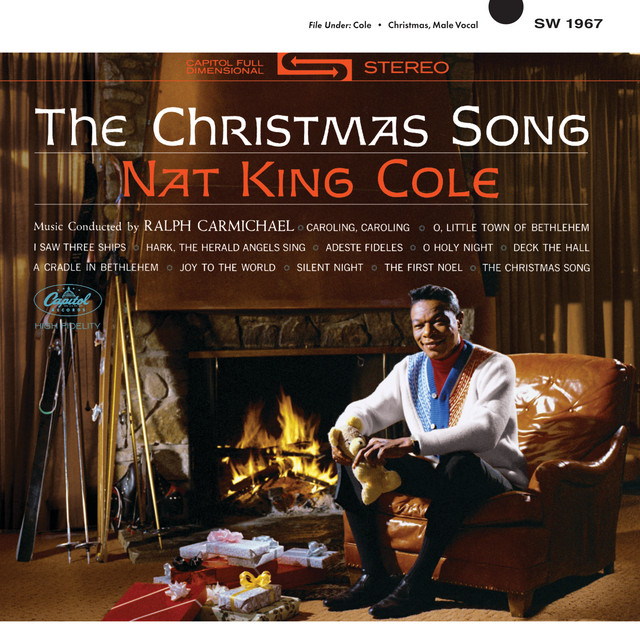
Arranged by Charles Grean and Pete Rugolo, and conducted by Ralph Carmichael, this March 30, 1961 session at New York City’s Capitol Studios is the only stereo recording Cole did of the song which explains why it has supplanted all previous versions, evolving as the one that everyone hears. 

While Cole performed piano duties on the 1946 recordings, Buddy Cole (no relation) and Ernie Hayes played the piano on the 1953 and 1961 versions, respectively.

            The only reason why “The Christmas Song” was not a number one hit was because at the same time of its release the King Cole Trio’s “I Love You for Sentimental Reasons” was at the top of the charts.

            “The Christmas Song” transformed Nat King Cole from a talented jazz artist who sang and played piano in a trio, to a popular singer along the lines of Bing Crosby and Frank Sinatra, a master balladeer, an amazing achievement for an African American entertainer at this time. With “The Christmas Song,” the public and the Capitol Records producers heard a different type of singer.   From now on, Cole focused his musical skills away from the piano and in front of the orchestra.

As Epstein sums up in his biography of Cole, “For almost a quarter of a century his art had been the art of the ensemble jazz musician.  Now he was becoming . . . a lyric soloist.” (158)  By 1948, the King Cole Trio as an artistic entity was no more.

Freddy Cole remembers that his older brother “loved the song” and loved to sing it the rest of his days.

Tormé and Wells would eventually go their separate ways enjoying success in the entertainment industry, Tormé donning several creative musical hats most notably as a preeminent jazz stylist, and Wells as a multiple Emmy-winning television producer.

Even though Mel Tormé wrote additional holiday tunes including “The Christmas Feeling” and “Christmas Was Made for Children,” he and Wells never did write a song as popular as they did in 1946.  In fact, he often referred to the money earned from the composition as his “financial pleasure.”

The Wall Street Journal’s drama critic Terry Teachout describes “The Christmas Song” as “one of the most harmonically complex songs ever to become a hit.”  Still, if it weren’t for Christmas songs of the past airing on radio and in stores each holiday season, few people under the age of 50 would know who Mel Tormé or Bing Crosby were.  It is a shame how artists who were once extremely popular over the course of decades can quickly vanish from public awareness.

To further illustrate this, Daisy Tormé, one of Mel’s five children, related a story about her father who was at the storied Farmer’s Market shopping center near Hollywood when carolers strolled by singing “The Christmas Song.”  After joining the singers in finishing the song, one of them told him that he “wasn’t that bad of a singer.”  When Tormé half-mockingly said that he had recorded a few records in his time, the young man asked, “how many?”  “Ninety,” he responded.

One of the main reasons why the song resonates so deeply is the line “and so I’m offering this simple phrase to kids from one to ninety-two,” an unusual use of first person point of view where the songwriter directly addresses the listener.  

Daisy wistfully reveals that “every time I hear the song, I get emotional because it is like getting a hug from my father.”

            “The Christmas Song” had a career-lasting impact on all three men.   This was the biggest hit Nat King Cole, Mel Tormé, and Bob Wells ever had, and it is safe to say that without that song, just as with “White Christmas” and Bing Crosby, the legacy of these men in the 21st century would be diminished if not entirely forgotten.
Neil Diamond or Billy Joel?

If you were stranded on a deserted island and had to hear music from Neil Diamond or Billy Joel, which one would you choose?

Diamond and Joel (those are their real last names) have been on my mind recently after seeing “A Beautiful Noise: The Neil Diamond Musical” and the HBO Max documentary “Billy Joel:  And So It Goes.”  Both projects serve as close to an autobiography fans are ever going to get from these artists.

It’s remarkable to see the similarities of these pop stars. Each was born in the 1940s in a different borough of New York City:  Diamond in Brooklyn (1941) and Joel in The Bronx (1949). 

Both men are Jewish and moved to Los Angeles when they were starting out.  Diamond never left, while Joel returned to New York after a few years.

Neil Diamond and Billy Joel are two of the most prolific rock and roll singer/songwriters of their time.  Diamond has sold more than 130 million records worldwide while Joel has sold more than 150 million.

When first recording, both lacked confidence in their singing voices which is hard to believe.  Try imagining other singers recording their songs.

Each artist had 13 Top Ten hits during their prime.  For Neil Diamond, that was from 1966 to 1982; his first hit was “Cherry, Cherry”; his last was “Heartlight” in 1982.  Other hits include: “Cracklin’ Rosie,” “Shilo,” “Forever in Blue Jeans”, “Solitary Man,” “Sweet Caroline,” “Song Sung Blue,” “America,” “Kentucky Woman,” “You Don’t Bring Me Flowers,” “I Am I Said.”

For Billy Joel, that was from 1973 to 1993; his first hit was “Piano Man” and his last was “The River of Dreams.”  Other hits include:  “Just the Way You Are,” “Movin’ Out,” “A Matter of Trust,” “An Innocent Man,” “She’s Always a Woman,” “It’s Still Rock and Roll to Me,” “New York State of Mind,” “My Life,” “The Longest Time,” “Allentown.”  Most impressive is that Joel had success covering more years but with fewer studio albums:  13 to Diamond’s 43.

Each artist wrote a song that shared a common opening of naming famous people.  Diamond’s 1970 “Done Too Soon” mentions 25 celebrities while Joel’s 1989 “We Didn’t Start the Fire” references 118 including major news stories.  

Both married multiple times:  Diamond had three wives, Joel four.  Diamond has four children, Joel three daughters, two from his most recent marriage.  Both smoked, though Diamond quit decades ago.

Their upbringing differed, however.  Diamond had a more stable home life than Joel’s with supportive parents.  While their envisioned their son getting a steady job like a doctor, they gave him a guitar for his 16th birthday. 

Joel was a prodigy who began playing piano at age four.  His parents were supportive of their son’s talent, but his father wanted him to play classical music.  When he heard Billy adding a rock and roll tempo to a classic piece, he smacked the side of his heard.  At eight years old, his father left the family.  Years later, Joel sought out his father to discover he was living in Vienna and had another son.

Joel has struggled with depression and addiction.  In his early 20’s, he attempted suicide twice.

Both artists extended their careers delivering electric live performances:  Diamond performed over 1,700 concerts while Joel did over 2,400.  They toured into their 70’s.

Earlier this year, Joel was diagnosed with normal pressure hydrocephalus (NPH) forcing him to cancel concerts.  Diamond finished touring in 2017 after discovering he had Parkinson’s disease.

Back to my opening question, who would I choose if I were on that deserted island?  While I have enjoyed both men’s oeuvre, I’d have to choose Billy Joel.  His melodies have more complexity, his lyrics speak to a deeper analysis of the human spirit and his songs haven’t dated as much as Diamond’s. 

Additionally, as an instrumentalist, Joel is a more gifted pianist than Diamond is a guitarist. 

Recently I saw “A Beautiful Noise” and noticed that most of the audience was older than me.  When I saw Joel’s Madison Square Garden concert on TV last fall, most of the audience was younger.  His musicality still resonates.

Neil Diamond

Billy Joel

Memories by John Williams

As a teenager, the section of any record store where I spent the majority of time browsing was the film soundtracks.  Most of my albums were scores by my favorite composers:  Bernard Herrman, Jerry Goldsmith, Danny Elfman, and John Williams.

At that time, one could not see a film again unless it was shown on television or re-released in movie theaters.  So, I’d play an album on my record player and allow the music to wash over me as I reclined on my bed staring up at the blank ceiling, letting the musical leitmotivs conjure up specific scenes from the film.

This month, a new documentary premiered, “Music by John Williams,” chronicling the maestro’s life story.  Its subtitle could be “With Collaboration by Steven Spielberg” because in nearly all of his 34 films, the film director has worked with Williams.

It is an unprecedented nearly half a century of work that began in 1975 with “Jaws” and was last renewed in 2022 with “The Fabelmans.”  When they first worked together, Spielberg was 29 and Williams 43.

During this second half of his life, Williams found a second career as a conductor, first as the principal conductor with the Boston Pops Orchestra for 14 years, then as a guest conductor with orchestras around the world (he’ll head the Berlin Philharmonic in June 2025).

Try to imagine any of these movies without hearing in your head their musical themes:  “Jaws,” “Star Wars,” “Close Encounters of the Third Kind,” “Superman,” “Raiders of the Lost Ark,” “E.T.,” “Jurassic Park,” “Schindler’s List,” or “Harry Potter and the Sorcerer’s Stone.”

Every time a person sees a film released by Universal, one also hears the fanfare music by Williams.  That goes for the Olympics and NBC News.  And to think he began this body of work in his mid-40’s.  Little did he know his life was only at its mid-point.

His most stirring pieces can rouse one’s spirits:  Superman flying through the sky, the Jedi fighters diving deep into the Death Star, Indiana Jones dashing away from danger onto a plane, the boys’ bicycling across the moon.  His most quiet passages can bring tears:  Elliot saying goodbye to E.T., Schindler at a loss upon receiving a gold watch from the Jewish people whose lives he saved.

Despite technological advances in devices that could write the notes for him on a scoresheet, he adheres to his laborious habit of writing down each note by hand.  And, with few exceptions, chooses not to employ electronic instruments because, as he says, you can’t hear a musician’s soul through a synthesizer.

Of course, there are scores of films Williams worked on that aren’t memorable.  There are critics who view his work as derivative and schmaltzy.  But there’s no denying that some of his compositions will never be forgotten.

John Williams and Steven Spielberg.

Ode to a Record Player

As I continue downsizing the stuff in my garage, I came across the compact stereo player I had as a child.

I don’t recall exactly when my parents got me the stereo, but when examining the date of the records and especially the 45’s I still have in my possession, it was in 1966 when I was eight years old.

That stereo was a huge item for me because it meant I didn’t have to use the old cabinet stereo in the living room to play records which was shared by the entire family.  I could play the music I wanted when I wanted to in my bedroom which was actually a den shared with my brother (nine years older than me).

Stereo systems were manufactured in wooden cabinets just like radios.  Then companies produced smaller, portable versions like the one I had.

And mine was a Philco, model no. P-1446-GY, with a 6-transitor stereo amplifier and a 4-speed automatic record changer.

The reason I had a Philco stereo is because my father worked for Philco as a salesman for a short time.  By the way, the name is not for the founders of the company, rather for the city where it was founded, Philadelphia.  The company has long ago gone out of business.

This stereo had four speed settings:  78, 45, 33, 16.  Yes, 16.  I never used that setting which led me to do a bit of research on history of records.

In 1910, shellac records were manufactured to be played at 78 ¼ revolutions per minute (rpm).  Shellac, however, made these 10-inch albums brittle like glass so one had to be careful in handling them.

In 1948, 12-inch vinyl records were produced.  Not only were they more durable than shellac, they provided more content since the speed was cut to 33 1/3 rpm, thus the term long-playing or LP came into use.

In 1949, smaller 7-inch discs were introduced.  With an rpm of 45, they had one song on each side.  Music producers would put the song that had the most hit potential on the A-side and hide an inferior song on the B-side.  Sometimes the B-side song outsold the A-side one.

In 1957, record companies came out with discs that played at 16 2/3 rpm, half the speed of 33’s.  These were mainly for spoken material like book readings or speeches.  This format lasted less than 15 years.

The design of my compact stereo, about the size of a boxy microwave, was genius.  Like a suitcase, there was a latch on top that upon opening would unleash two external speakers that swung out on hinges.  Each speaker could be unhooked from the turntable and placed a few feet away to enhance the stereo separation.  

My stereo was gray and I loved the blue/green color of the speakers’ fabric.  I was so proud to have it that I used a piece of gold-colored carbon paper that imprinted my name on top of it so no one else in the house would forget that it was mine.

To release the turntable required inserting a finger in a small hole to pull it down in an upright position.  

To this day, I still have several of the 45 records my parents bought me that first year in 1966.  Here were some of my purchases:

  • Sonny and Cher’s “The Beat Goes On”
  • The Herman Hermits’ “Leaning on the Lamp Post”
  • Neil Hefti’s “Batman Theme” (for the popular TV series)
  • Sam the Sham’s “Lil Red Ridin’ Hood”
  • The Royal Guardsmen’s “Snoopy vs. the Red Baron”
  • Nancy Sinatra’s “The Last of the Secret Agents?” (which decades later was signed by Nancy herself)

Remember, this music was chosen by an 8-year-old.

That Philco stereo has traveled with me over the years even though I haven’t used it since  my late teens.  That’s when the stereo marketplace changed.  Music lovers had to purchase all the components separately:  turntable, speakers and receivers (a smart money-making move by those manufacturers).

I was curious if my stereo still worked, so I carried it out from the garage onto the patio. 

I pulled out the power cord neatly folded up and stored in the back, and plugged it in.  I moved the power lever near the tonearm to the “on” position.

Unbelievably, the turntable turned.  It still worked! 

Quickly I went into the house to retrieve one of the few 78 records I still had, Frank Sinatra singing “Day by Day” on the Columbia label.  It was produced on Aug. 22, 1945, 11 days before the end of World War Two.

I gently placed it on the turntable.  I gingerly moved the tonearm onto the record.  And I could hear Frankie singing, though the volume was extremely low.   Adjusting the volume control had no effect on making the sound louder so clearly the machine had diminished.

I turned it off, then turned it back on again.  And guess what?

It stopped working.

It’s as if my Philco stereo had enough life to be played one more time, and that was it.

That’s when I knew I had to say goodbye to a piece of my childhood.  It served me well.

I took photos and video of the stereo to show my wife and sons who had never seen it opened up.

When my youngest son saw the footage, he encouraged me to keep it, texting, “You could repurpose it and make it a time capsule of sorts.”  I briefly thought about it, but I couldn’t imagine where in my house I would put the Philco.  It would end up back in the garage, never to be seen for who knows how long.

I called my city’s refuse department which picked up bulky items that didn’t fit in one’s trash cans and placed my Philco stereo along with a couple of other items on the parkway on my trash pick-up day.

Periodically, that morning, I would peer out my front window to see if the items were picked up yet.  About the third time I looked out, I noticed that the Philco stereo was gone while the other items were still there.

Someone had come by and rescued the Philco.  I’d like to think that whoever took it had a fondness for old record players.  I hope it brightens someone else’s life as it did my childhood. 

And whoever has it will know whose stereo this was for “Brian” remains embossed on top of it.  It will always be mine.

And the Music Goes Round and Round

Do you have storage areas in your house where you keep old things that you never use again?

One of my storage areas is the cabinet above my wife’s closet.  That is where I’ve kepy my entire album collection since I was a child.

I’ve boxed and moved these LPs several times over the years as I moved.  The last time I played any vinyl was about 15 years ago.  That’s when we purchased a new component for the entertainment center which needed its own shelf.  The turntable had to go—above my wife’s closet.

Since then, I have a mini-museum hidden from the public.  Until we had the house painted this year.

Having to box items before the painters came in provided us an opportunity to really clean house.

In recent years, I’ve learned to part with lots of material items.  Just this weekend, I discarded boxes of financial documents such as utility bills and pay stubs going back to 1990.  I mean, why was I saving this stuff?

Just as my wife and I donated hundreds of books to used bookstores earlier this month, I decided the time had come to look at my record collection one last time, and only keep the most special albums.

I have an extensive collection of Bernard Herrmann soundtracks.  He’s my favorite film composer; most people know his music if not his name.  You can hear his scores in “Psycho” and “Citizen Kane.”  So I didn’t let any of those go.

Then I have a small collection of Frank Sinatra albums.  Unlike the Herrmann albums which I bought brand new, the Sinatra stuff was bought used in the 1990’s when I first got hooked into the crooner.  Those I kept as well.

I found a local record store who accepted donations and transported four banker’s boxes full of albums over there.  My wife and I were expecting to drop off the boxes and drive off.

At Atomic Records in Burbank, however, we didn’t leave so quickly.  It turns out that Nick and his brother who have run the store for 30 years actually pay money for records that they can sell in their store.

More unexpected than that was Nick himself.  As we stood outside his loading dock in the alley, like a jeweler using a loop, he meticulously looked at every album, sometimes removing the album from its sleeve to check its condition, often commenting on the artist.

In the 45 minutes this process took, it was as if Ralph Edwards had come back from the dead to surprise me, “Brian, this is your life!”  Nick was a music archaeologist examining my stash, and I was reviewing the evolution of my musical tastes, from boy to man.

There were two albums from The Royal Guardians, a rock group whose 1966 hit song “Snoopy vs. the Red Baron” was the impetus for me to buy their music.  Comedy albums from Don Rickles, and one from Mickey Katz whose son, Joel Grey, is more well known.  

Nick regaled us with stories of studio musicians who worked on some of these albums, including a drummer who continued practicing his craft until his death at 90,whose house was across from the alley from the record store.

What made this experience even more memorable was that the house where I grew up as a baby was behind that old musician’s house.  Incredible.

Nick told us about his house in Japan (his wife is Japanese) and how the vinyl produced there is superior in quality than those manufactured in the states.  I asked him how large of a collection has he ever seen.  The biggest ones have been around 10,000 records which requires renting a truck to haul the stuff back to his store.

I felt pride when Nick finished perusing my lifetime of rccords and had compiled a much larger pile of those he could sell versus those who he couldn’t.

“What happens to those you can’t sell, Nick?  Do you throw them away?” I asked.

“Oh no,” he replied.  “I place them outside my store at night, and when I return the next morning, they’re gone.”

It made me feel good that the music that brought me enjoyment since I was a little boy, could bring enjoyment to others.  What treasures do you have hidden in your home which could brighten other people’s lives?