
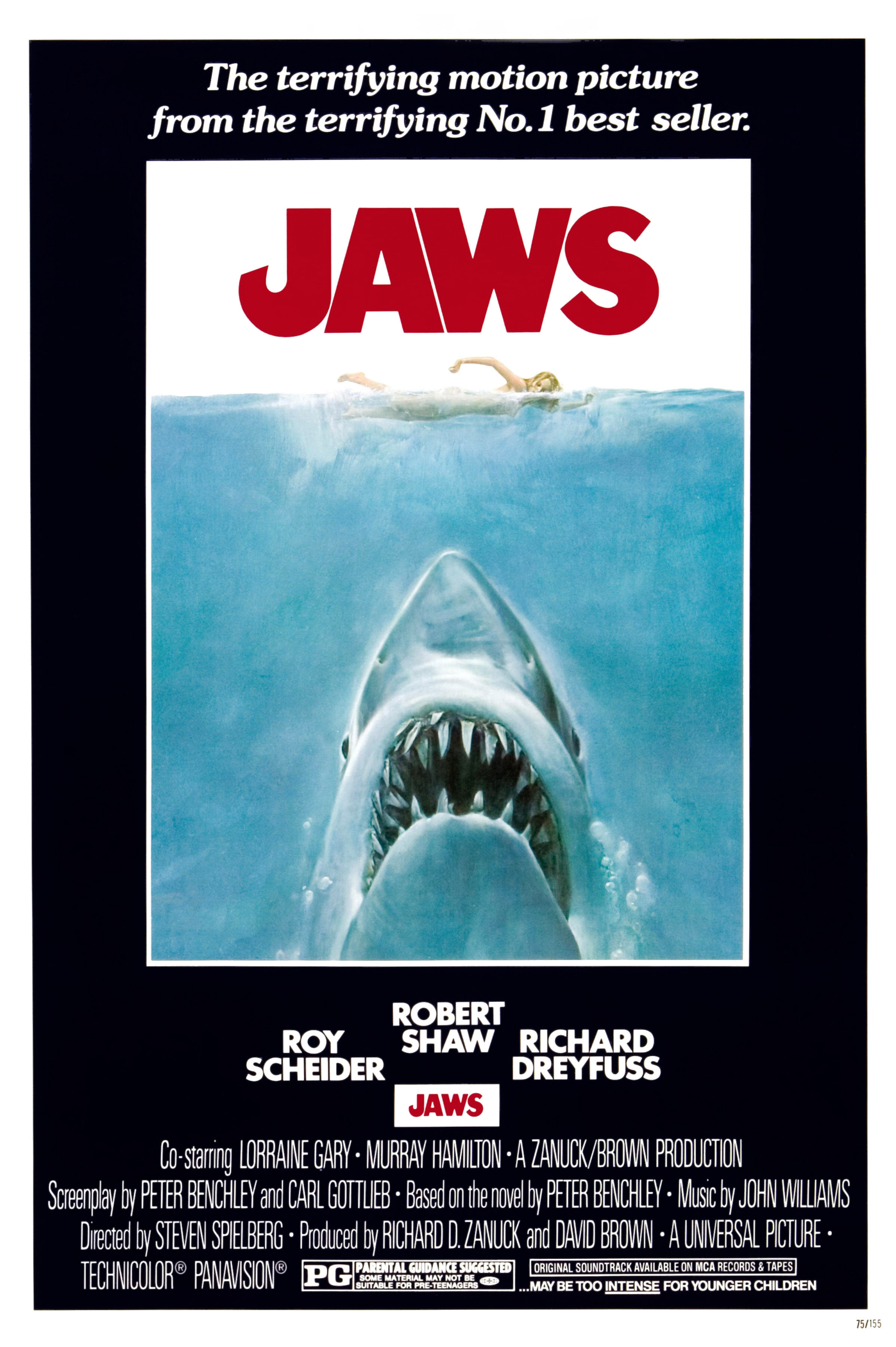
It’s hard to believe that half a century has passed since “Jaws” was released in July of 1975. I was in Palm Springs with my family when we went to see it at the Plaza theatre. I took the paperback of the Peter Benchley novel with me so that I could finish it in our motel room before seeing the movie. It remains one of the most memorable film experiences I’ve ever had.
Earlier this month I watched “Jaws” for the first time in many years along with my 21-year-old son who had never seen it.
In order to temper unrealistic expectations on his part regarding a 50-year-old film, I explained to him that “Jaws” was made 20 years before CGI came on to the scene. Spielberg was one of the first directors to use CGI for 1994’s “Jurassic Park.” Even then, he insisted on using practical effects with the dinosaurs and not rely solely on computers.
Smartly, Spielberg reveals little of the shark until the climax. When it is finally shown as it breaches onto the boat swallowing Shaw’s Quint, the use of a mechanical puppet is frightening since he is actually interacting with a real object and not reacting to nothing but a green screen.My son came away impressed.
What elevates “Jaws” from other excellent movies is the impact its success had on the movie industry.
The summer blockbuster. Before “Jaws,” studios did not release their best pictures during the summer due to many theatres not having air-conditioning. Once “Jaws” opened to packed theatres, it became clear that people would stand in line for an “event” film no matter the weather. “Jaws” earned $260 million domestically in its initial release. Two years later, “Star Wars” would open Memorial Day weekend and surpass that mark, earning over $300 million. Thus, the summer blockbuster was born.
Wide release. Eschewing the common exhibition practice of opening a film in a small number of theatres, gradually expanding over several weeks, “Jaws” opened in over 400 theatres. This greatly boosted its earnings at a faster clip (this was before multiplexes became commonplace).
Trailers on TV. It was uncommon to advertise new movies on television. Universal Studios aired commercials a few days before the release of “Jaws” thus generating high interest.
Just as Alfred Hitchcock’s 1960 “Psycho” made people afraid to take showers, “Jaws” made people fearful of swimming in the ocean.
Additionally, “Jaws” catapulted the careers of Steven Spielberg, John Williams (who would go on and score the bulk of Spielberg’s canon), Roy Scheider, and Richard Dreyfuss. Before “Jaws,” Robert Shaw had established himself as an in-demand character actor for a quarter of a century which explains why his name had the highest position in the credits. Sadly, his career would be cut short, dying three years later at age 51from a heart attack.
Making “Jaws” took longer and cost more than expected. Since much of the film was shot in Martha’s Vineyard off the coast of Massachusetts, the sea water damaged the 25-foot mechanical shark that was the film’s main prop leading to numerous delays.
The original 55 days of shooting tripled to 159, while the $3.5 million budget ballooned to $12 million. A new documentary on the making of the movie depicts the stress that Spielberg was under, especially when hearing that studio bosses were thinking of shutting down the production.
Once filming finished, Spielberg had a full-blown panic attack. He thought he would never work in Hollywood again.
Spielberg revealed that it took him years to overcome this anxiety, often having nightmares even after achieving great success. To overcome his trauma, he would secretly board the Orca boat, part of the “Jaws” stop on the Universal Hollywood Studios tour, and lay down in the cabin to calm himself.
 Crosby Chronicles