Bob Barker

The definition of a barker:  someone who stands in front of a theater and calls to passersby to attract customers.

How apropos that legendary TV host Bob Barker was born with that last name.

For over half of a century, from 1956-2007, Bob has been getting our attention to “come on down” to watch him on television every weekday hosting “Truth of Consequences” (1956-1975) and “The Price is Right” (1972-2007).

He won 14 Daytime Emmys for Outstanding Game Show Host—a record.  And in 2004 he was inducted into the Academy of Television Arts & Sciences Hall of Fame.

I have always loved Bob Barker.  I first got to know Bob Barker when he was the host of “Truth or Consequences” (ToC) which was taped in Hollywood at KTTV, Channel 11 in Los Angeles and syndicated across the country.

What made Bob so special was his ad-libbing with contestants, his comic timing reminiscent of Bob Hope or Jack Benny.  He clearly enjoyed talking to people and he was so good at his job.

He also seemed like a genuinely nice man.

I was surprised to learn that only one book on Bob Barker has ever been published:  “Priceless Memories,” an autobiography co-wrote with Digby Diehl in 2009.  Honestly, it is not that engaging, hearing him explain how he got his jobs in television.  I got the Audible version with him reading the book.  While it’s pleasant hearing his voice, he is reading from a script.  Even if much of the book is from his own words, it comes across as stilted. 

A much better version of the same information can be found in a three-hour interview done on July 7, 2000.  One of the best sources of learning about TV history are these multi-part interviews called Emmy TV Legends that can be found on YouTube done a while ago; the interviewer is Fred Westbrook.

These are priceless interviews, capturing TV pioneers while they were still living.  For anyone interested in the history of television or movies, these are must-see interviews.

At the time of the interview, Bob was 76 years old.  He looks like he’s in his early 60’s.  His memory is sharp and he never stumbles as he speaks.  More importantly, the interview showcases his innate knack at telling engaging stories off the top of his head, the same skill that made “Truth or Consequences” and “The Price is Right” worth watching.  He comes across as genuine and funny.

It’s a shame that most of the “ToC” shows do not exist; you can find a handful online.  Unlike “Price is Right,” you don’t have to suffer through the over-exuberance of the contestants and frenetic pacing of the show.  There was a lot more of Bob being Bob in the “ToC” shows.

Fans have created YouTube videos such as “Best Moments of The Price is Right.”  Some of them are over two hours long.  Though the picture quality is often poor, you can’t stop watching these clips over the years just because of Bob Barker’s affinity with people.  You just have to fast-forward through the announcer reading ads for products to get to the few minutes of pleasure when Bob talks to the contestants.  Those impromptu moments that kept the show fresh and on the air for as long as it was, a reminder that these shows were taped live. 

Today Bob Barker is still around at age 99.  He hasn’t been seen in public for a number of years.  Here’s hoping his remaining days will be good ones.  This Dec. 12 he will turn 100.

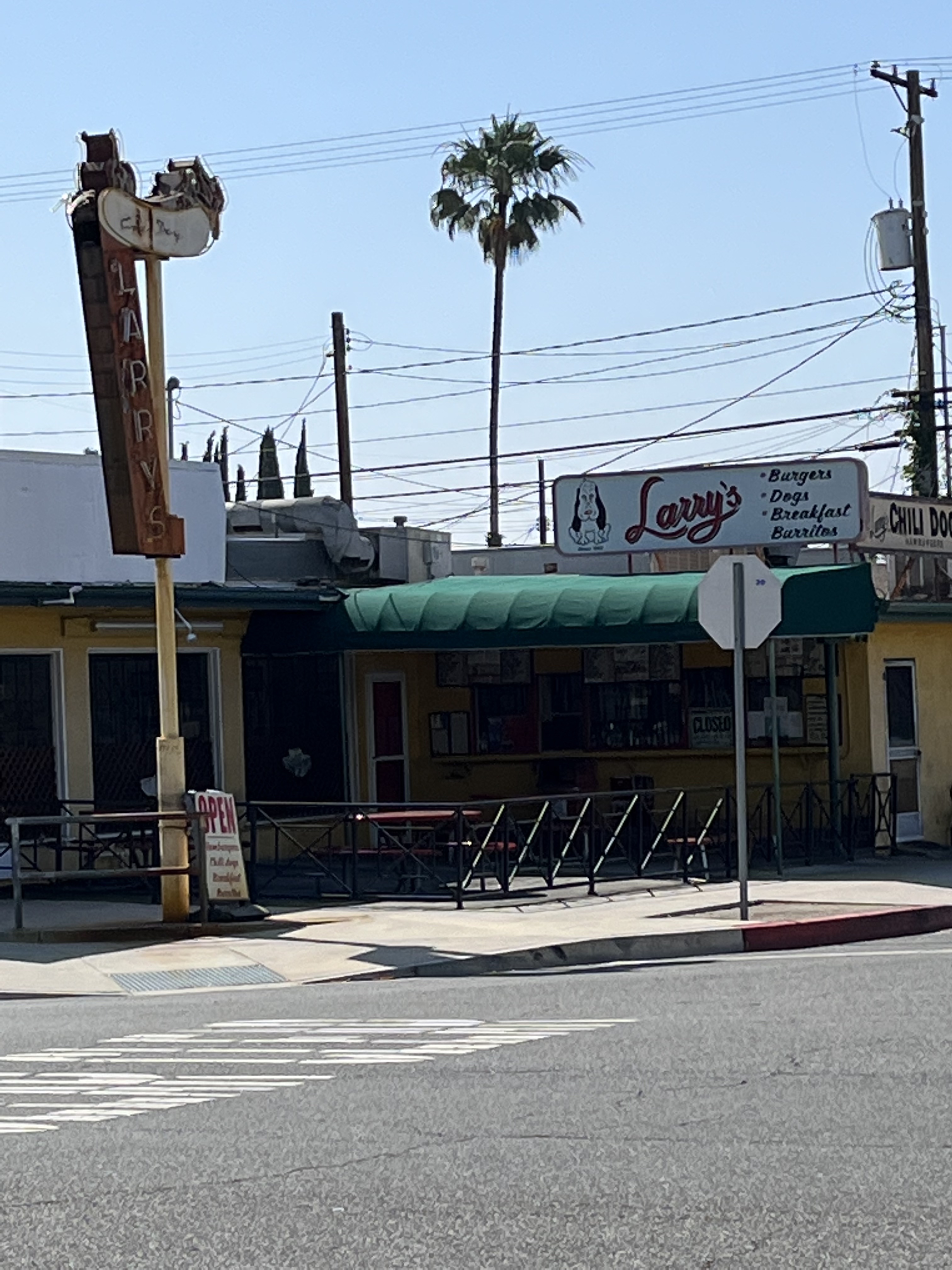
Happiness at Larry’s Chili Dogs

If you had to put a price on happiness, how much would it be:  $100,000?  $1,000,000?

What if I told you that you could be happy once a week for $11, would you do it?

If so, head on over to Larry’s Chili Dogs on Burbank Blvd. in Burbank and for $11 you can get the best breakfast burrito in Burbank, maybe even the San Fernando Valley.

In every bite, your tastebuds are stimulated with potatoes, eggs, bacon, sausage, cheese, and if you are brave, hot salsa.  It will make you so happy that the extended smile on your face will hurt.

And for this joyful five-minute (or three if you have no patience) taste explosion at the princely sum of $11. 

I’ve had breakfast burritos that are good but often have one or more failings to their recipe:  too eggy, too much salt, not enough protein, uncooked potatoes or bacon, not the right kind of cheese.  Sometimes the ingredients burn through the tortilla making it impossible to eat with your hands.  Did I mention too much salt?

Here’s the best part:  the breakfast burrito isn’t even what Larry’s is known for.

Their signature dish is a chili cheese dog—mustard, onion, chili—and a cherry coke.  Not a pre-mixed one in a can, but a coke with cherry syrup pumped (hopefully several pumps) into it.

The chili recipe is mild and complements the snap of the high-quality hot dog.  This isn’t anything you’d find at Wienerschnitzel (do those still exist?).  And unlike a more famous chili dog in the L.A. area, Pink’s, this one tastes better and you don’t have to wait in line for 45 minutes.

John, the proprietor, whose last name I am embarrassed to admit I still don’t know, has run this Burbank tradition for over 20 years.  He is one of the nicest men I know.  He works very hard, six days a week, and loves his job.  He opens, closes, cooks, cleans, and answers the phone though he does have help from family members.

Larry’s opened in 1952 and John is only the third owner as far as I know.  Neither of the other men were named Larry.  According to John, “Larry” is the nickname of the original owner’s girlfriend.  If anyone out there can verify this, please let me know.

I first went to Larry’s when I was a teenager in high school.  Then it was located at 3111 W. Burbank Blvd. about across the street where it is today. It was an unusual space, steps from the sidewalk leading up to a landing where you would place your order; picnic tables spread around.  The space was so large that today a two-story office building has replaced it.

Larry’s is a reminder of Burbank’s past that isn’t a museum, but a thriving eatery, year after year after year.

I don’t know a businessman who works as hard as John does in a line of work that brings so much joy to so many regulars

I daresay that what John provides to the City of Burbank is worthy of recognition, do you hear that Chamber of Commerce?

More than that tasty diner-style food, the memories Larry’s evokes is worth the price of admission . . . and an extra inch in one’s waist size.

My Oscar Moment

Half of a century.  On the face of it, quite a long time.  But when the 50 years relates to a special time in your life, it is shocking how short it feels.

It doesn’t seem that long ago, June 12, 1973, when my life changed for one minute.  I call it my Oscar moment.

Luther Burbank Junior High School in Burbank was holding its award assembly in the morning for its ninth grade students who were moving on to high school. 

I was serving as an usher, a person who handed out programs to parents, and who assisted them locating seats.  It was one of the duties I had as a member of the California Junior Scholastic Federation (CJSF).

I had a sense that I was going to be acknowledged in some way because my mother received an invitation to attend. 

The auditorium had two aisles which divided the seating section into three areas.  I was stationed in the back of the right-hand side aisle.  My mom and sister were sitting in the middle.

Mrs. Alice Nastasi, my social studies teacher in 8th grade, was on stage at the podium stationed on the left-hand side ready to announce the next award, the coveted Faculty Memorial Scholarship Award for Outstanding Scholastic Achievement.

Mrs. Nastasi was a short, dark-haired woman who was all business, from the tailored dresses she wore to her adult-like manner of speaking to students.  She was very strict in terms of the high quality of work she expected all students to do.  And her piercing brown eyes magnified through black-rimmed glasses seemed as if she were directly talking to you. 

She would start every class period at the very second the tardy bell finished.  She’d sit on top of a student’s desk and utter the famous words, “Please get out two sheets of paper with the proper heading at the top on the right.”  Boom, boom, boom.  The message:  learning is too important to waste any precious second.

Some students mocked her name, Mrs. Nasty, because they didn’t want to do all the work that she demanded.  I, on the other hand, admired her approach and emulated her style once I became a teacher. 

One of the few school projects that I cherish to this day was for her class when I wrote a business proposal on how to expand public transportation across Los Angeles to decrease congestion on the freeways.  It required me to do extensive research including receiving materials from government agencies.

Mrs. Nastasi was also the faculty advisor to the CJSF and, because of her, I had my first foray into a group to which I could belong.

When she announced through the loudspeakers “the Faculty Memorial Scholarship award goes to Brian Crosby,” it was as close as I’ll ever get to winning an Oscar. 

Like a dream, I floated down the aisle past my sister who was positioning herself for a good vantage point to take a photo.  The applause I heard seemed distant, my body moving but my senses dulled.

I proudly crossed the stage and saw a big smile on Mrs. Nastasi as she handed me the two and a half-foot high trophy.  I returned to the rear of the auditorium.  The whole thing lasted but a minute.  Oh, but what a minute. 

To this day I still think there was a photo of what my eyes saw, showing my sister standing in the aisle with the camera near her head—that’s how vivid the moment is to me.  Unfortunately, the photo that she took of me being handed the trophy does not exist; the flash on the camera wasn’t strong enough to properly process the dark photo.

The only photo I have of that day is after the award show concluded, my sister framing my mother and I with the trophy outside the auditorium. 

I look at that 15-year-old oddball kid with thick, longish hair, who instead of wearing age-appropriate attire wore grown-up clothes:   an unbuttoned long-sleeved chocolate brown sweater and matching dress slacks, and a pink and blue vertical-striped dress shirt buttoned all the way to my neck, my belly pressing tightly against the fabric.

I looked like I didn’t belong to the other boys, more like a foreigner.  I was the fat kid with bad skin that no one wanted to be friends with.  I was the kid who stayed inside during recess and lunch to help teachers, avoiding the loneliness of being on the playground with other kids, none of whom wanted to be next to me.

I may have been invisible to my peers, but to my teachers, I was seen.  They were well aware that my father had died four months earlier.  Some knew about my battle with out-of-control psoriasis which accounted for my strange haircut and wardrobe.   Surely some of this played a part in choosing me for this honor over an equally talented student. 

That two and a half-foot trophy composed of glued-together metal, wood and plastic represents the fortitude that the teachers, my role models, thought about me and how I held my life together at the time of despair.

And here I am at age 65, reflecting about my life, re-playing this moment again and again in my mind, as if the more times I remember it, the more real it becomes. 

To this day, it remains the only trophy I have ever won in my life.  Unlike most boys, I never received a trophy for a sport because I wasn’t athletic, or earned a merit badge because I wasn’t a scout.

I still have the trophy though it has broken into pieces.  For decades I’ve stored it in a box, but now I’m thinking of repairing it, polishing it and displaying it on a shelf, a reminder that sometimes the unpopular fat kid wins—even for just a moment.

Close-up of Brian with a smile on his face, then freeze frame.  Print it.

Brian standing next to his mother holding up the trophy, June 12, 1973.

Live Outside the Box

News item:  Beyoncé and Jay-Z purchase a $200 million Malibu mansion.

Even if you had all the money in the world, wouldn’t $20 million be sufficient?  Think of how much good the remaining $180 million could do for the less-fortunate.  I mean, how many bedrooms and bathrooms can a person use?

If you feel envy of their new digs, remember this:  Beyoncé and Jay-Z still live in a box just like you and I.

Oh, it’s quite an enormous box to be sure—40,000 square feet.  But it’s still a confined interior space whether it’s a seaside castle or a 120-square foot studio apartment—it remains a box.

We spend most of our lives living in confined boxed spaces.  From womb to crib to bed to house to car to classroom to office to hospital to coffin. 

Boxes are how we store things including ourselves.

Four walls, a ceiling, a floor—basic design of human life.

People spend huge amounts of disposable income filling in that space, placing art on walls, hanging lights from ceilings, laying rugs on floors,

Think of all the boxes that you now have in your home.   A house is a box divided into smaller boxes.  The bedrooms, the bathrooms, the closets, the dressers, the shower stall, the appliances.  Years ago, a refrigerator was referred to as the icebox.

Inside the closets are boxes of shoes, memorabilia, photos.

Then we take boxes from inside the house and put them in a larger box called a garage.

You see, our lives are mostly lived in confined spaces.  People think prison is confining when in reality we are all confined.

That’s why whenever I go on a trip, I favor visiting outdoor natural settings, rural areas over cities.  National parks in particular have no walls and definitely no ceilings—unless you count the sky and the stars.

These treasured, preserved areas remind us of how insignificant and finite our lives are.  Human history makes up such an infinitesimal speck in the earth’s existence.

It is humbling to visit Zion National Park and admire mountains that are millions of years old.

Wherever you live, pay attention to the topography that was there before you were born and will remain after you are long gone.  We are but brief visitors to this blessed planet.

If more people would keep this reality in mind, environmental issues such as global warming and climate change could more effectively be tackled.  But there’s something in the human mind that prevents people from thinking beyond their lifespan.  Parents often understand this concept whenever they talk about leaving the planet better off for their children and their grandchildren.

When people talk about personal freedoms, they are overlooking the one that is so obvious, we take it for granted:  the freedom to go outside every day, watching the clouds, feeling the cool air, hearing the birds.  Because these things are always there, it’s as if they are never there, an invisible sensory experience waiting to be savored.

For what matters most is when we walk outside the box.  And that’s something celebrities like Beyoncé and Jay-Z can’t easily do.

Family Photos

How many boxes of family photos do you have?  Are they stored in closets, under beds, in the garage?

Mine are all over the place.  About 20 percent are nicely stored in photo albums, the old-fashioned ones with plastic sleeves.  However, another 50 percent are in plastic baggies grouped together for a specific event like someone’s birthday, or in the original envelopes from the drug store.  Then the remaining 30 percent are in the Cloud, most of which have never been printed on paper.

Such randomness didn’t concern me until recently when I wanted to verify information about my life by double-checking photos. That’s when I realized I now have a new hobby to do in my retirement—cataloguing and archiving the entire Crosby photo album.

The most preserved photos in terms of dates and information are actually the ones I took myself with a Kodak Instamatic S-20 camera which my parents got me for my 10th birthday.  For the next decade, 1968-1977, I shot 52 rolls of film.

Serving as the de facto documentarian for the family, I memorialized the houses we lived in, our dogs, birthday parties, trips to Disneyland, Christmas mornings, and milestones such as graduations, anniversaries, and even the family’s first color TV.  Imagine people today posing near their newest TV.

As soon as the photos were developed at the local drug store, I would fastidiously write complete sentence captions on the back including the date.

I then would select only the best photos to put in a photo album; blurry photos were out for it made me look incompetent as a photographer.  Little did I know that over a half-century later, I would be cherishing those blurry images for they captured loved ones no longer around; thank goodness I never discarded any of them.  And the few that have been misplaced I have been able to re-print since I kept all the negatives.

As I peruse old photos covering decades of time, I realize that I am putting together my family’s history and, in turn, a history of photography.

The earliest photos I have are in black and white as are most of my elementary school photos.  Not until fifth grade in 1968 was the switch made to color.  What’s odd is that the quality of the older black and white photos are superior than the newer color ones which have faded badly.

Another aspect of school photos which has changed is individual photos.  From kindergarten through fourth grade, my schools took one whole class photo outside in the spring time; the next year they switched to individual photos. 

The photography studios would print a large composite of each class assembling the individual photos.  However, a special dynamic was lost.  In the whole class photos, relationships among kids can be observed, friends standing next to friends, as well as personalities shown (a few gigglers).  Also, the whole class photos allowed one to see the full body of the students.  Girls would wear nice dresses, boys would wear nice shirts, and sometimes if a child was in scouts, they would wear their uniforms.  All of that is lost with the individual photo. 

One other major change in photography from the pre-digital to the digital age:  more useless  photos are taken.  With digital, people never take just one photo of a pose—more like 3 or 5—but who needs multiple photos of the same pose? 

When you had a roll of film with 24 exposures and you went on a trip to Disneyland, you knew you had to be selective in what photos you shot.  You wouldn’t want to take 10 photos on Main Street, leaving 14 for the other lands in the park.  In other words, you had to be smarter.

Those of us living today are quite fortunate to have photographic technology during our whole lifetime, something almost all humans who ever lived before us never experienced.

Warning: This Column may be Inappropriate to College Students

CROSBY CHRONICLE:  trigger warnings

You know the warnings that are shown at the beginning of TV programs that content may be inappropriate for some people?  Well, some college students want those warnings issued by professors before they enter a classroom.

A few weeks ago, Cornell University’s student assembly unanimously voted to send a resolution to President Martha E. Pollack that required all professors to issue content or trigger warnings on material that some may deem inappropriate. 

In a matter of days Pollack vetoed the resolution.  She said in a statement that such a recommendation “would infringe on our core commitment to academic freedom and freedom of inquiry, and are at odds with the goals of a Cornell education.”

Alex Morey, the director of campus rights advocacy for the Foundation for Individual Rights and Expression, told the New York Times that, “what was unique about the Cornell situation is they rapidly turned in a response that was a ‘hard no . . . a very firm defense of what it means to get an education.”

This was a rare rebuke of the current trend at college campuses of students not wishing to hear subject matter or speakers who espouse views that differ with their own.

Just last month at Stanford University, an invited speaker, a Trump-appointed judge, was interrupted by hecklers.  What made matters worse was that an administrator who was present at the event defended the students, refusing to support the guest speaker even after he asked for her help in settling down the unruly crowd.

Neeli Bendapudi, president of Pennsylvania State University, defended Penn State’s legal and moral obligation to host speakers whose views some students may find counter to their own.  “For centuries, higher education has fought against censorship and for the principle that the best way to combat speech is with more speech,” she said in a video.

Amna Khalid, a history professor at Carleton College in Northfield, Minn., claims that issuing such warnings don’t work, “reducing [student] identities to traumatic events and “infantilizes” students whom professors should be preparing for adult life, she told the New York Times.  Mandating warnings on academic materials infringes on professors’ role in helping student sharpen thinking skills.

“Life happens to you while you are driving, while you are walking, while you are in the supermarket,” she said. “The most challenging moments in life rarely come with warning.”

Hear, hear. 

Universities are institutions where freedom of speech can thrive, where young people are exposed to a wide array of ideas which may challenge their own view of life.  Ideally, graduates exit college not only with a diploma, but with a wider acceptance of divergent views; in other words, more tolerant people enter society—which is best for everyone.

Reach Out and Touch Someone

I have a binder where I put receipts for everything my wife and I have spent on maintaining and improving our house for the past 24 years.

On the front inside pocket is a flyer I saved that was in a little box planted in the front yard of this house in order to attract buyers.

It is officially the first page of the binder.

And on this flyer are two color photos:  the largest of the house, the smallest of the real estate agent’s smiling face.

I don’t know why but I had an urge to locate this realtor online to see if she was still selling property.  And lo and behold, she was—in Indio not Burbank.

I texted her a photo of the flyer and told her how much we have enjoyed living in the house for the past 24 years. 

Within an hour, she texted me back, thrilled that I would contact her.

“That was so thoughtful of you!  So happy that you and your wife are still enjoying your beautiful home!   Thanks for thinking of me.”

Weeks earlier I had another encounter with someone from my past.  My favorite math teacher Mr. Kolpas had recently passed away and I called his widow to offer my condolences.  I told her that I would make a copy of a film with her and her husband who acted in a film I made in my late teens. 

When I sent her the video, she was overwhelmed with joy, not only to see Mr. Kolpas but to see the house that was their home for so many years; she shared it with her daughters and grandchildren.

“Thanks so much. Wow. We were so young. Kids got a kick out of it. Thanks!”

Around the same time, I was going through my other 8mm movies I made when I was a teenager, some I hadn’t seen in nearly 40 years.  I screened them for my wife, and during one film I discovered something.  Back in 1975, I filmed a shot across the street from a gas station.  I It is the same gas station that I still go today to service my cars.  And the owner, Tony, is still there since he opened his business in 1971.

I had to show him this because he appeared in the long shot.  What’s interesting, too, is you can see a car being attended to by three different employees in uniforms.  That was the time when gas stations began transitioning from full-service to no-service.  And a younger Tony was next to the car.

I took my cell phone, videotaped that scene and the next day drove over to Tony’s and said, “Guest what, Tony?  I’ve known you since I was 17 years old.”  Then I showed him the video.

“Your son wasn’t born yet?” I asked.

“Not yet,” referring to the middle-aged man who works with his father.

“Boy, I wish we could go back to those days!” he wistfully commented.

It makes me feel good to let others know I am thinking of them or that I appreciate them.  And I was especially glad to do it when they are still around.  Connecting with others helps us feel human and alive.

Loss of Polite Language

When I was an English teacher, I instructed my students to elevate not denigrate their language.  I wanted them to raise their level of discourse so others would view them in a positive light.

It has become a harder lesson to teach when one observes how people speak today.  It seems that being careful with one’s words is a quant antiquated ideal.

When newly elected Barack Obama gave his first State of the Union address to Congress in 2009, Republican congressman Joe Wilson shouted, “You lie!”

It was so shocking that a congressman would interrupt a president while delivering his most important speech of the year that Congress voted to condemn him for making that remark.

Fourteen years later, as Joe Biden is giving his second State of the Union address, congresswoman Marjorie Taylor Greene yells out, “liar!” which is worse than saying “you lie.”  Other Republicans, yelled “bull—-!”

And were any of these elected officials condemned for their obscenities?  No.

Remember how solemn this annual speech by the American President used to be for over 200 years?

Since when did the House Chamber of the United States turn into a wrestling match? This special club of 535 men and women can’t be polite for 90 minutes for a once-a-year event that is televised for all to see.  They end up disrespecting their own line of work by acting like thugs.

Later that same night, I’m watching LeBron James overtake Kareem Abdul Jabbar’s all-time scoring NBA record in career points, and you’d think this guy who many believe is the greatest of all time would recognize the gravity of the situation when they stop the game to allow him to speak about his achievement, but no. 

Instead of choosing to show humility and grace, he finishes his speech on live television with his family and mother in attendance by uttering, “F—, man.”  It seemed he was speechless, so the first word that popped into his head when he couldn’t think of what to say was the f-word.

It proves that no matter that how many billions he has in his bank account, he is bankrupt when it comes to class.

I can’t imagine the NBA all-time greats like Jerry West or Magic Johnson speaking that way at that moment.   In my book, LBJ will never surpass KAJ in terms of intelligence and dignity.  That record remains his alone.

In my last column, I wrote about how certain groups these days are hunting literature from the past in order to delete words that would not be acceptable today.  I wrote that these people should focus on the time in which they live.

For example, funny how the people with sensitivities to the word “fat” look the other way when it comes to the other f-word.

Why is it okay for the word b—- to be ubiquitous in nearly every Hollywood production?  I’ve seen reality shows where the characters’ nicknames for their friends is the b-word. 

Do you know that one of the films nominated for Best Animated Short Film is called “My Year of D—-,” a slang word for penis.  The film was made by women.  I wonder if a man had made a similar film called “My Year of P—-” if that would have received the same positive attention?

When it comes to entertainment, word appropriateness is in the ear of the beholder.

Why aren’t more people outraged that a six-year-old actor says the f-word?  Whenever I’m watching a film or TV show, and a young actor starts saying foul language, it immediately sucks me out of the drama, my mind thinking about the type of parents who would prostitute their own children to say filthy things just for a paycheck. 

If the parents aren’t going to monitor it, then it is up to the writers, producers and directors who clearly don’t have a moral compass.

All the money in the world would not persuade me to allow my 7-year-old to say “f— that s—” for the sake of entertainment.

And often the adult characters in these scenes don’t react in any negative way to their “children” swearing.  I don’t get it.

“The White Lotus” had a family where the teenaged daughter spoke frankly about sexual activities using slang that would make a sailor blush.  And not a raised eyebrow was seen on either her mother or father.

That show, by the way, has sex scenes in it that would have earned it an X rating by the MPAA back in the 1970’s.

It would not surprise me if a full-blown porn film is made by HBO or Netflix very soon.

Songwriter Cole Porter said it best with his aptly titled tune, “Anything Goes.”

“Good authors too who once knew better words
Now only use four-letter words
Writing prose.

Anything goes.”

That was written in 1934.

Sanctity of Published Work

Unlike writers who work for the stage, screen or television, published authors have the security of knowing that their books will forever remain the same, the purest form of expression untouched by others.

Until now.

We are living at a time when certain groups have sprung up who serve as surrogate word police, alerting publishers of words or images from past books that should be changed to reflect today’s sensibilities.

First there was the cleansing of Dr. Seuss books in 2021 whose books have sold more than 700 million copies.  The estate of Ted Geisel (Seuss) expunged six of his 60 books due to racial stereotypes.  The only way to find them is at a library or by buying overpriced used books.

People easily forget that during the time when these artifacts were created, they were acceptable in that society.  When understanding history, one is supposed to see it through the eyes of those who lived during that time period, not the present time.

The most recent children’s author under attack (by the way, why children’s literature is the epicenter of such scrutiny is anyone’s guess) is Roald Dahl, another popular author with more than 300 million books sold.

Among the hundreds of changes, Augustus Gloop from Charlie and the Chocolate Factory, the boy who gorged himself on chocolate and ended up falling into a river of chocolate, will no longer be described as “fat” but “enormous.”  By the way, “fat” and “enormous” are not exact synonyms. 

Also, the Oompa-Loompas will be called “small people” instead of “small men.”

What triggered this whitewashing of Dahl was Netflix which owns some of his titles and is interested in dramatizing them for their streaming service.  That’s when Inclusive Minds, one of the word police groups, combed through Dahl’s works and found offensive material.

The group emphatically denies on their website that they “do not edit or rewrite text,” yet this is exactly what results from their findings..  Such irony is one Dahl would have relished if he were alive today.

Unlike the Dr. Seuss situation, a compromise was recently announced by Puffin who publishes Dahl’s books.   Due to the intense pressure of notable people like author Salman Rushdie, who himself has been a victim of censorship, and U.K. Prime Minister Rishi Sunak, who said that “works of literature [should be] preserved and not airbrushed,” Puffin will continue publishing the original versions as well as the censored version.

This reminds me of what happened back in 2011, when a version of Mark Twain’s The Adventures of Huckleberry Finn was published with the N-word replaced with the word “slave.”  The earthquake of such a controversy rippled through op-ed pieces across the country.  However, the original version was never threatened, and continues being published today.

If there is material in a book from the past, the wrong way to deal with it is to erase it as if it never existed.  Instead, use the offensive material as teachable moments.

That’s what I did when teaching Charles Dickens’ Oliver Twist.  The villainous thief Fagin is a Jewish stereotype.  Dickens mostly ignores using his name, dehumanizing him by referring to him as the Jew.  A Jewish acquaintance of Dickens pointed this out to him and so, on his own volition, he went back and removed most of those references.

Sharing this story with my students opens up an opportunity to discuss anti-Semitism.  However, we still read, study and discuss his important novel which mainly focuses on society turning a blind eye to childhood poverty—an issue that still resonates nearly 200 years later.

When I taught literature, I would get my students excited at the notion that Charles Dickens is talking to them from 150 years ago.  This is how he saw his world, a vision that was captured and forever sealed.  There are no video or audio recordings of his voice.  The vocabulary and sentence structure represent his voice.

And now strangers from another century want to alter author’s voices.

I was watching an old Dick Cavett show with Groucho Marx from 1971. The two were talking about the word “lady” and how inappropriate some felt it was, especially those in the Women’s Liberation movement.  “Woman” was considered a more appropriate word to use. 

Today, however, “woman” has become a dirty word for some, to be replaced with “they” to eliminate any whiff of gender.  Who knows what people will think of “they” come 2073? 

If one must examine every artifact from the past and judge it on current trends, then put a disclaimer next to the item, but leave the original work alone, as is. 

I see much to criticize in our culture today.  Let’s work on fixing the way we live now.

One can’t change the past, but one can change the present.  That’s where the focus needs to be.

Rants: What is it about . . . ?

What is it about . . .?

What is it about grown adult men in the prime of their life out and about during weekdays as if they have no job?

As a retiree, I’m always surprised to see men in the 20-40 age range at the Y exercising at 9 or 10 in the morning.

Whenever I see men out in public during business hours, I think, “What mischief are these guys up to?”

It makes you wonder how many of them work for organized crime or are scofflaws siphoning off government programs such as welfare and social security disability.

Which leads me to my next “what is it about”:

What is it about today’s economy where unemployment is extremely low yet businesses struggle filling positions? Restaurants, retail stores and supermarkets are under staffed and have been ever since the pandemic. 

I would like to see a study on the percentage of adults are not employed and aren’t seeking employment, and how are they contributing to society in a meaningful way. Some journalist should look into this.

What is it about the electric bicycles known as E-bikes which have taken over the highways, that go as fast as cars, yet require no licensing and no plates?  These are renegades dangerously driving around us without stopping for anything.

Instead of the government looking into outlawing gas lawn mowers and stoves, why no regulations or legislation about a matter like E-bikes which has the potential of raising the already high death rate on the road?

Speaking of gas . . .

What is it about the price of natural gas which has increased to the level of a monthly mortgage payment?

I came as close as I ever have in my life of fainting when I opened my most recent SoCalGas utility bill.  From November’s $179 to December’s $274 to January’s $660—and that’s for two people.  WHAT?!?

While I had read in the newspaper about the spike in the natural gas market, I still wasn’t prepared for that number.

I called the gas company to find out what is going on and got a recording saying that “no one can answer your call right now” and directed me to go to their website.  No email was provided for customers’ concerns.

By the way, nothing on the message mentioned the exorbitant high bills that customers across the Southland are receiving.

When I went to their website, I was anticipating a banner across the screen saying something like, “We understand you almost had a heart attack when opening your latest gas bill, but let us explain.” 

Instead, one has to hunt around under their “news” tab to find an article about the spike in natural gas prices buried among more trivial articles.

Two weeks ago, I contacted my local state representatives, Assemblymember Laura Friedman and State Senator Anthony Portantino, who have not responded to me at all.  The least they can do is bounce back a form “thank you for your comments.”

The most aggravating thing about this isn’t the money, but the lack of communication on the part of SoCalGas.   How about an insert with everyone’s bill explaining what is happening?  How about acknowledging the outrage customers have by updating the recording on their company phone line?  Instead, you get the sense the attitude is, “Shh, don’t say anything and the problem will go away.”

It makes one want to boycott gas appliances.