
Recap from Part 1
I discovered that a long‑cherished family art piece—an old, faded print my mother displayed for decades—is actually a reproduction of Marc Chagall’s “Rabbi with Torah,” a connection deeply tied to her family’s Jewish and Ukrainian heritage. This revelation sparks a quest to restore or replace the artwork, culminating in an unexpected twist when an eagerly purchased replacement is abruptly refunded.
Part 2
I immediately emailed the eBay seller as to why I received a refund after my purchase was confirmed just minutes earlier. He replied, “I pressed the wrong button. The correct is I’m refunding you.”
You mean this work had already been sold?
“Just to be clear—I am not getting this painting? It meant so much to me.”
Seller: “I do have quite a few Chagall works so let me show you if you’re interested.”
Wow. I was beside myself with a mixture of confusion, anger and despair.
Was this an honest mistake by the seller, or a calculated ploy to sell other items he had?
I was so distraught over this news I couldn’t think straight. My wife encouraged me to just reframe the original and display it.
But I couldn’t help myself. I was determined to keep hunting.
By 11:30 a.m., I found one on Etsy. However, the photo of the item looked digitized and fake. I asked the seller if he would upload actual photos and he did. Unlike the one I had originally purchased on eBay, this one had visible folds and other imperfections, plus was more expensive than the other. I hesitated to buy it.
All day Sunday and into Monday I kept checking for any more available copies. I found an excellent reproduction from an eBay seller who had a physical art store. As I was on the page, a notification popped up on my screen that this item was in another potential buyer’s shopping cart.
I panicked. I had to act fast. I didn’t want to lose another chance. I frantically pressed the BUY IT NOW button.
On Monday, Feb. 2 at 11:49 a.m. I got confirmation of my purchase. Yes! But after what happened to me on Saturday, I stifled my enthusiasm. I had to make sure that the sale was for real this time.
At 7:30 a.m. on Tuesday, I received an email directly from Mark, who works for Meibohm Fine Arts in East Aurora, New York. Celebrating their 125th anniversary, the granddaughter of the founder runs the family business. He thanked me for the purchase. Whew!
He shared with me that “most of the New/Old Stock items in our archive have not seen the light of day in over 75+ years, a rarity indeed, and that this vintage mid-century lithograph has never been framed.”
Mark would mail the litho via UPS later that day, with an expected delivery on the following Monday. However, this was occurring during the intense cold storm that pummeled much of the country with snow and ice so I had to keep watch over the progress of its movement to notice if there were any delays.
Anxiety came over me as the week wore on without any progress on the UPS tracking website. I checked it on Wed., Thur., Fri., and Sat., but the needle hadn’t moved from the “dropped off” status. Steps still to come: “on the way,” “out for delivery” and “delivered.”
Mark kept checking on it as well, even on his days off. I wouldn’t be able to contact UPS until Monday so I had to sweat it out that the item was not lost.
In the middle of Sunday, I received a notification from UPS that the lithograph was arriving on Monday after all. However, the status had not changed. Which one was correct?
On Monday morning, movement finally occurred on the UPS tracking tool.
9:56 a.m. “on the way”
10:53 am. “out for delivery”
With an expected delivery by 9:00 p.m., that gave me 10 more hours to wait; throughout the day, Mark and I exchanged emails. Now that’s remarkable customer service!
Sure enough, at 6:11 p.m., “ding-dong.”
I opened the door to see the UPS man holding on to a long-tubed package. Finally—relief. As I signed for it, I gave the driver a 30-second recap of the whole story.
I had my wife videotape me as I opened the tube and gently pulled out the rolled-up lithograph. Marc did a meticulous job of wrapping it with arrows marked on the tiny pieces of tape guiding me on the correct direction to pull the tape.
When I removed the print out of its protective bubble wrap and unfolded it, I was quite impressed by the pristine condition of something that was manufactured several decades ago. In the at the bottom in the white margin surrounding the poster was information about it, including the following:
Marc Chagall (1887- ).
In other words, when these lithographs were produced by the New York Graphic Society in the 1950’s and 1960’s, Chagall was still alive (he died in 1985).
And there it was, side-by-side with my Mom’s version. Quite a difference. If I had any doubt about buying a newer one, it vanished: this beautiful lithograph was the proper decision.
With this enhanced reproduction, the details of the work can more clearly be seen.
In the foreground is the rabbi wearing traditional dress appropriate for praying. He holds a Torah scroll, the most important text in the Jewish religion. A snow-covered scene of a Russian village emerges in the background (condensed from the Stedelijk Museum’s website).
In the upper left of the painting, there is a pig and a lamppost; in the upper right, there is a horsedrawn sled with an occupant or two. Behind that are a few straw-roof houses that complete the depiction of a shtetl.
The work symbolizes that Judaism survives even in a bleak world. And unlike Mom’s poster, Chagall’s signature is clearly visible in the bottom right corner.
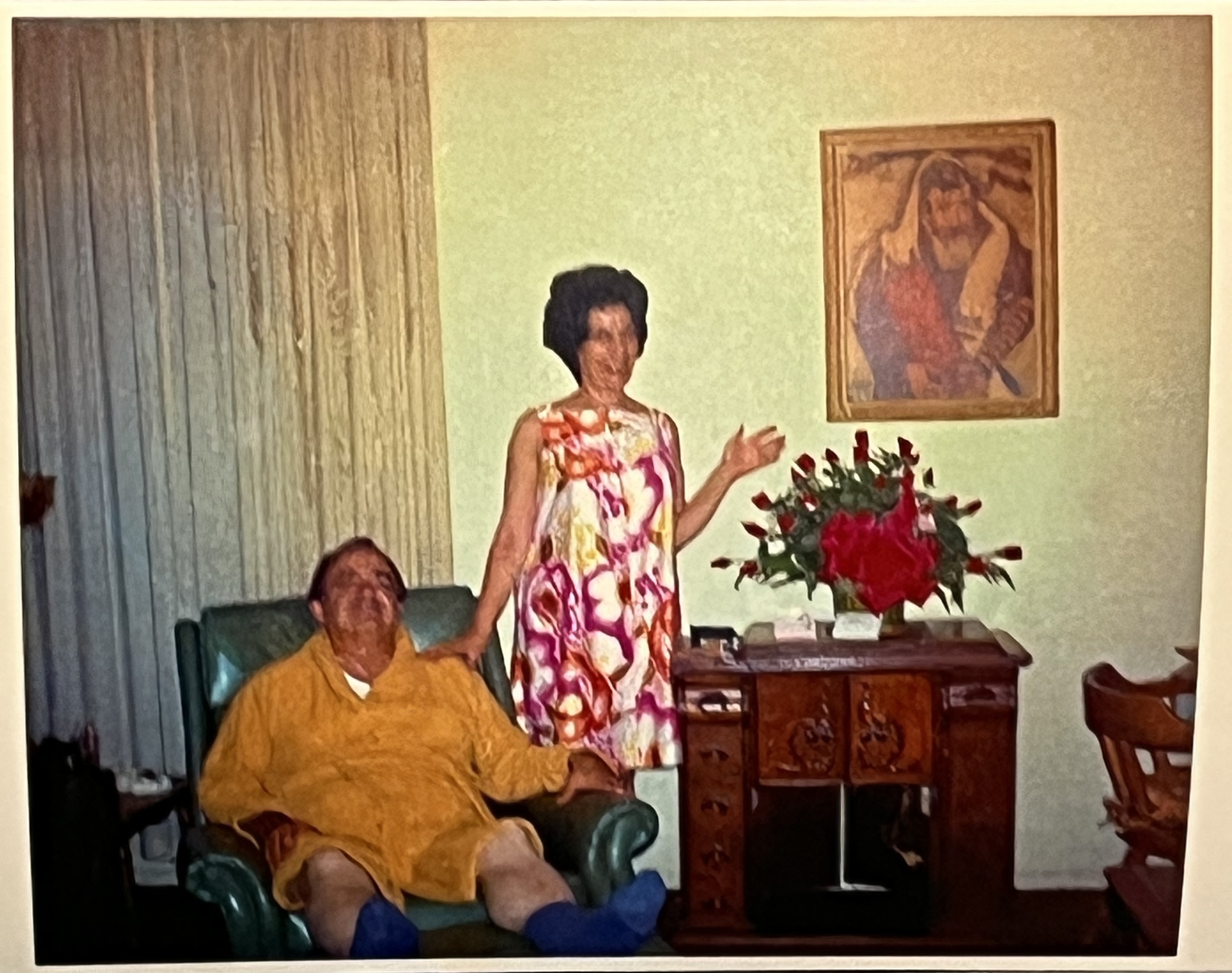

Dad sitting in his recliner he got for Father’s Day and Mom showing off roses she got for their wedding anniversary with the Chagall painting on the wall (left); the new lithograph framed and hung in our dining room (right).
It took two weeks and now it is on display in our dining room. The rabbi is looking to his left where the opening is to our living room, welcoming visitors who walk through the portal.
My mother would have been impressed to see the full beauty of the work that captured her eye so many decades ago, now protected for generations with museum-quality UV-resistant glass and frame, a fitting, living tribute to her and my maternal grandparents who I never knew.
It makes one think of the serendipity of this adventure.
If not for having watched that “CBS Sunday Morning” show, none of this would have happened.
If not for that eBay seller canceling my purchase, I would not have ended up with a high-quality lithograph from a high-class business as Meibohm Fine Arts.
I wish I could share with Mom everything I’ve learned—but maybe, just maybe, she already knows.


 Crosby Chronicles