Resurrecting a Family Heirloom (Part 2)

Recap from Part 1

I discovered that a long‑cherished family art piece—an old, faded print my mother displayed for decades—is actually a reproduction of Marc Chagall’s “Rabbi with Torah,” a connection deeply tied to her family’s Jewish and Ukrainian heritage. This revelation sparks a quest to restore or replace the artwork, culminating in an unexpected twist when an eagerly purchased replacement is abruptly refunded.

Part 2

I immediately emailed the eBay seller as to why I received a refund after my purchase was confirmed just minutes earlier.  He replied, “I pressed the wrong button. The correct is I’m refunding you.”

You mean this work had already been sold?

“Just to be clear—I am not getting this painting?  It meant so much to me.”

Seller: “I do have quite a few Chagall works so let me show you if you’re interested.”

Wow.  I was beside myself with a mixture of confusion, anger and despair.

Was this an honest mistake by the seller, or a calculated ploy to sell other items he had?

I was so distraught over this news I couldn’t think straight.  My wife encouraged me to just reframe the original and display it. 

But I couldn’t help myself.  I was determined to keep hunting.

By 11:30 a.m., I found one on Etsy.  However, the photo of the item looked digitized and fake. I asked the seller if he would upload actual photos and he did.  Unlike the one I had originally purchased on eBay, this one had visible folds and other imperfections, plus was more expensive than the other.   I hesitated to buy it.

All day Sunday and into Monday I kept checking for any more available copies.  I found an excellent reproduction from an eBay seller who had a physical art store.  As I was on the page, a notification popped up on my screen that this item was in another potential buyer’s shopping cart. 

I panicked.  I had to act fast.  I didn’t want to lose another chance.  I frantically pressed the BUY IT NOW button. 

On Monday, Feb. 2 at 11:49 a.m. I got confirmation of my purchase.  Yes!  But after what happened to me on Saturday, I stifled my enthusiasm.  I had to make sure that the sale was for real this time.

At 7:30 a.m. on Tuesday, I received an email directly from Mark, who works for Meibohm Fine Arts in East Aurora, New York.  Celebrating their 125th anniversary, the granddaughter of the founder runs the family business.  He thanked me for the purchase.  Whew!

He shared with me that “most of the New/Old Stock items in our archive have not seen the light of day in over 75+ years, a rarity indeed, and that this vintage mid-century lithograph has never been framed.”

Mark would mail the litho via UPS later that day, with an expected delivery on the following Monday.  However, this was occurring during the intense cold storm that pummeled much of the country with snow and ice so I had to keep watch over the progress of its movement to notice if there were any delays.

Anxiety came over me as the week wore on without any progress on the UPS tracking website.  I checked it on Wed., Thur., Fri., and Sat., but the needle hadn’t moved from the “dropped off” status.  Steps still to come: “on the way,” “out for delivery” and “delivered.”  

Mark kept checking on it as well, even on his days off.  I wouldn’t be able to contact UPS until Monday so I had to sweat it out that the item was not lost.

In the middle of Sunday, I received a notification from UPS that the lithograph was arriving on Monday after all.  However, the status had not changed.  Which one was correct?

On Monday morning, movement finally occurred on the UPS tracking tool.

9:56 a.m. “on the way”

10:53 am. “out for delivery”

With an expected delivery by 9:00 p.m., that gave me 10 more hours to wait; throughout the day, Mark and I exchanged emails.  Now that’s remarkable customer service!

Sure enough, at 6:11 p.m., “ding-dong.” 

I opened the door to see the UPS man holding on to a long-tubed package.  Finally—relief.  As I signed for it, I gave the driver a 30-second recap of the whole story.

I had my wife videotape me as I opened the tube and gently pulled out the rolled-up lithograph.  Marc did a meticulous job of wrapping it with arrows marked on the tiny pieces of tape guiding me on the correct direction to pull the tape.

When I removed the print out of its protective bubble wrap and unfolded it, I was quite impressed by the pristine condition of something that was manufactured several decades ago.  In the at the bottom in the white margin surrounding the poster was information about it, including the following:

Marc Chagall (1887-    ). 

In other words, when these lithographs were produced by the New York Graphic Society in the 1950’s and 1960’s, Chagall was still alive (he died in 1985).

And there it was, side-by-side with my Mom’s version.  Quite a difference.  If I had any doubt about buying a newer one, it vanished:  this beautiful lithograph was the proper decision. 

With this enhanced reproduction, the details of the work can more clearly be seen.

In the foreground is the rabbi wearing traditional dress appropriate for praying.  He holds a Torah scroll, the most important text in the Jewish religion.  A snow-covered scene of a Russian village emerges in the background (condensed from the Stedelijk Museum’s website).

In the upper left of the painting, there is a pig and a lamppost; in the upper right, there is a horsedrawn sled with an occupant or two.  Behind that are a few straw-roof houses that complete the depiction of a shtetl.

The work symbolizes that Judaism survives even in a bleak world.  And unlike Mom’s poster, Chagall’s signature is clearly visible in the bottom right corner.
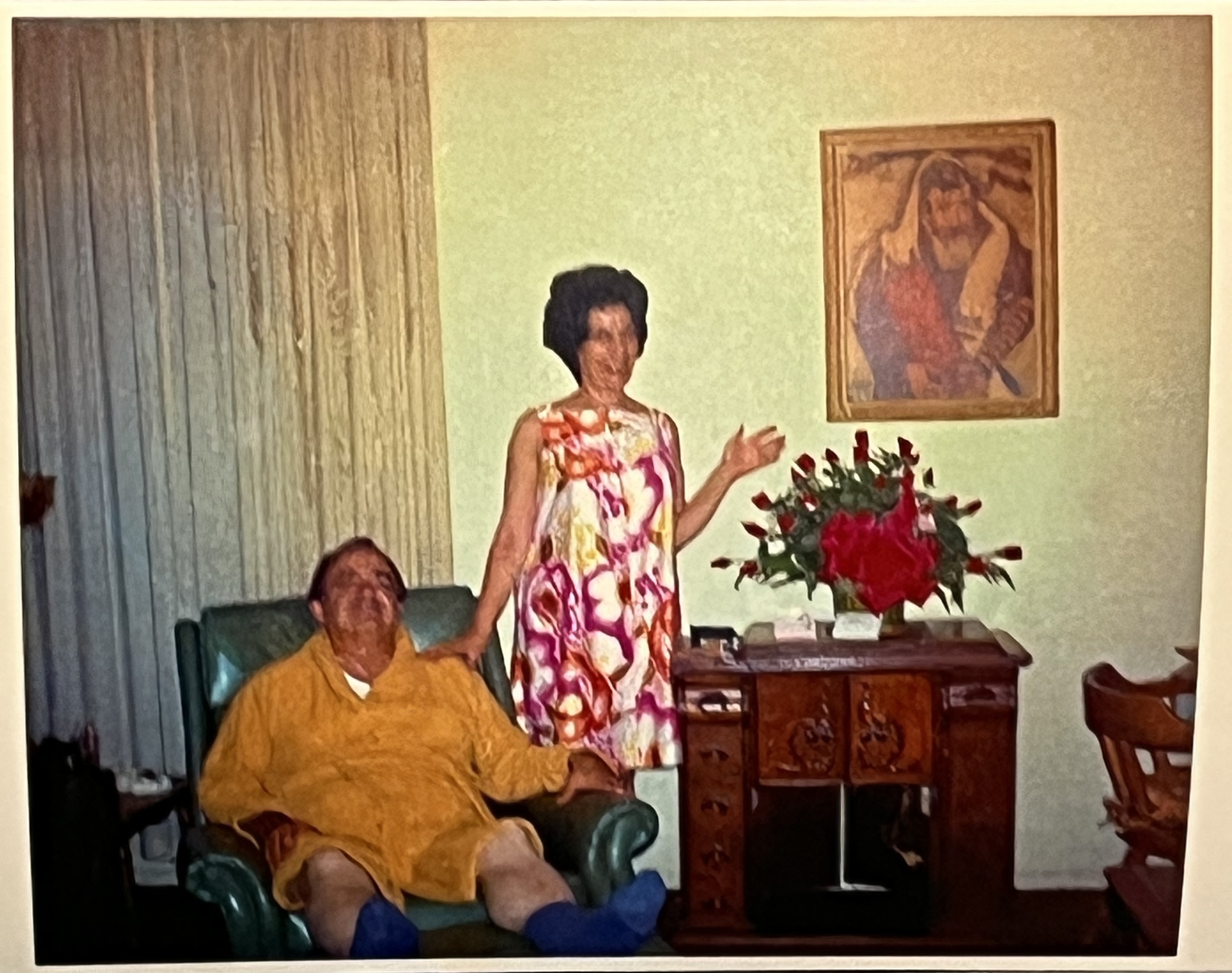
Dad sitting in his recliner he got for Father’s Day and Mom showing off roses she got for their wedding anniversary with the Chagall painting on the wall (left); the new lithograph framed and hung in our dining room (right).

It took two weeks and now it is on display in our dining room.  The rabbi is looking to his left where the opening is to our living room, welcoming visitors who walk through the portal.

My mother would have been impressed to see the full beauty of the work that captured her eye so many decades ago, now protected for generations with museum-quality UV-resistant glass and frame, a fitting, living tribute to her and my maternal grandparents who I never knew.

It makes one think of the serendipity of this adventure.

If not for having watched that “CBS Sunday Morning” show, none of this would have happened.

If not for that eBay seller canceling my purchase, I would not have ended up with a high-quality lithograph from a high-class business as Meibohm Fine Arts.

I wish I could share with Mom everything I’ve learned—but maybe, just maybe, she already knows.

Terry the Helper

Within a year of losing my sister-in-law, I have now lost my brother-in-law.  Both of my siblings are widowed, and the weight of that reality is heavy.

So what it was like having Terry as a brother-in-law?

I can’t recall the first time I saw him.  In the early years of Debra and Terry’s nearly 60-year relationship, I didn’t see him at all.

But I heard him.

It was the revving of his 1967 Chevy II Nova as he cruised past our house, his way of letting my sister know he came by.  He was shy and had a healthy fear of our father so not until Debra moved out to live with Terry did the family finally meet him.

Being seven years older than me, on the surface we had little in common—I, a teenager, and he in his 20’s—making conversations short.  

As the years passed, I got to know Terry as the family’s handyman.   I grew up ignorant on how to fix anything except putting mayonnaise on my bacon sandwiches, so to have someone who could make your car work better, make your house look better and, in turn, make your life better was a treasure not to take for granted.

One thing was clear:  Terry was a man of few words, preferring to speak with his actions.

I always felt guilty asking for his help so each time I needed his expertise, I’d call Debra.

“Ask Terry what he thinks I should do about this dent in my car.”

Debra, shouting at Terry, “Brian wants to know what to do about a dent in his car.”

Terry, in the background, “Tell him to bring it over.”

Other times when we needed something, there’d be a text from Debra, “We’re on our way.”

No hesitation.  Terry was pleased to help family, friends and neighbors. 

Every day he needed a project to work on, so if you needed anything fixed, he gladly came to the rescue, arriving with more tools in his SUV than a local hardware store.

Still, I made a point not to overuse the Terry hotline every time I needed help.  I didn’t want him to think I was leaning on him too much.  And the rare times when I could do handy work myself, such as disassembling and reassembling a toilet tank (thanks YouTube), I made sure to share my success with him so that he would think more highly of me. 

In later years, Terry and I grew closer.  I would make a point to not just say a quick “hi” to him when I visited but to engage with him in conversation.  I especially enjoyed making him laugh whenever I could.

It’s impossible to list everything he did for us over the past decades, but his handiwork is evidenced by those with whom he helped.  When I admire the white vinyl fence he erected along the length of our backyard, he’s still with us.

Terry’s love for driving and working on sports and vintage cars, winning several awards in contests, is why when our two sons (and their cousin) were in the Cub Scouts, my wife asked him to carve their Pinewood Derby cars and, not surprisingly, every car won First Place.  Terry was our secret sauce.

And as soon as he completed the job, he disappeared like a superhero.  No need to thank him because that’s just who he was—a helper.

Mr. Rogers once said that the world needs helpers.  Terry won first place in that department, too. 

His concern for those in his life had no limitations. He’d be there for them.  It was his way of showing his love.

Terry chose not to have the spotlight on himself which is why he felt uncomfortable with celebrations of his birthday.  He was just fine sitting on the couch watching old Westerns while others chatted elsewhere. 

In fact, if he were here reading this tribute, he would have walked to the den to watch “The Rifleman.”

Something else about Terry:  he never complained about the lousy health he was given.  At age 12 he was diagnosed with Type 1 diabetes, in his 40’s he had a double-transplant and more recently too many ailments to count.  I never once heard him whine or complain about his situation which is why others may have wrongly thought that he was healthy when he wasn’t.  As unlucky as he was with health, he got lucky with my sister, and having the love of friends and family. 

He’s left a void that can never be filled. In moments like this, I’m reminded of the saying: Don’t be sad that he’s gone—be grateful that we had him for as long as we did.

Resurrecting a Family Heirloom (Part 1)

As I went through my Sunday morning routine of making coffee and turning on the “CBS Sunday Morning” show, I watched a segment about people who rescued Jews during Nazi Germany.  Varian Fry was one of those people, an American journalist working for the Emergency Rescue Committee that helped refugees escape from France during 1940–1941, including some artists such as Marc Chagall.  On the screen flashed a montage of his art, and suddenly one caught my eye—a painting of a rabbi.  It seemed so familiar.

Four days later over lunch with my sister, as is our practice, we each took out little pieces of paper with topics to talk about since our last get together.  The first item on her list was the “CBS Sunday Morning” Chagall piece.

“Did you see that painting of a rabbi?” she asked me.  Suddenly, I knew instantly why that piece stuck with me.  “That’s like the painting Mom had hanging on the wall all those years.”  While not the same painting, it was similar in its subject matter.

When I returned home, I took a photo of Mom’s painting, researched the image, and, bingo, discovered that it was by Marc Chagall!  Titled “Rabbi with Torah” or “Rabbi met wetsrol,” the original is in the Stedelijk Museum in Amsterdam.

Two similar Marc Chagall paintings: “The Praying Jew” (left), “Rabbi with Torah” (right), my mother’s original print.

The painting Mom most admired, that she took with her from rental house to rental house, prominently displayed on a living room wall, turned out to be a famous work by a giant in the 20th century art world. I’m certain Mom never knew any of this; otherwise, she would have enjoyed regaling us with such joyous information.

Her eyes must have fixated on the Jewish-ness of the painting, a symbol of her heritage.  None of us three kids remember our house without it.

My guess is she spotted this framed poster in a furniture store which back in the day would have inexpensive art for sale. 

Another aspect of the painting which she didn’t realize was that the background depicted an aspect of her family history:  a scene from a shtetl, a small village common in Ukraine in the late 19th and early 20th centuries.

Like Chagall, her parents were born in Ukraine’s shtetls.  That connection would have meant so much to her.

Behind the rabbi figure, off in the distance, the ground is draped in snow, with a pig, a lamppost on the left, an adult and child on a sled pulled by a horse on the right, with a handful of small buildings on either side.  

Oddly, we never bothered to talk to Mom about this piece, its presence so constant like a light fixture, there all the time but not thought about.

When Mom passed away 20 years ago, it was one of a few items that I took.  Since the frame is dingy and the print faded and chipped (it never had glass), I didn’t consider displaying it in our house; instead, I secured it in the hall closet, with hanging jackets keeping it from tipping over.

Now, however, I had an urge to display it, most likely in our dining room where we had an empty wall as well as a special original charcoal drawing that was given to my wife’s great grandmother, who then gave it to her.  What better place to hang my mother’s dearest picture, further establishing the dining room as a place for family history.

I brought the artwork to a professional framer who had done quality work for me in the past to see if there was any way to bring it back to life.  The first question he asked upon laying eyes on it was, “Did either of your parents smoke?”  The answer was “yes.”  That was the main reason for the erosion of color in the print.  Not having glass to protect it was a contributing factor.  Using a Q-tip dipped with a solution of distilled water and Dawn dishwashing soap, he carefully touched a small portion of the poster.  While it lightened the work a bit, it wouldn’t be sufficient for it to look presentable. 

I made up my mind that if I hung my mother’s original, I had to get a new frame for it.  Of course, there was another option—locate a better print.

With the excitement of this family treasure consuming me, I quickly set out to find a higher quality version online.

While price was a factor, my number one priority was finding a copy of “Rabbi with Torah” that looked as closely to the original painting.  Of the half a dozen copies available, a few were poor reproductions; one was in worse condition than mine.

I settled on an eBay seller.  The price and condition were fair plus it was already framed.

On Friday, Jan. 30, at 2:00 p.m. I bought it. I was so thrilled; I couldn’t stop thinking of how it would look on my dining room wall, and how I would surprise my sister and brother when they’d come over to see it.

The next morning, I received the following emails from eBay:

10:12 a.m. – “The seller marked your order as shipped!”

10:41 a.m. – “Your refund is on its way!”

Wait, what?!  What did this mean, “refund”?

[To be continued.]

Blood on the Streets of Minneapolis

It didn’t take long for 2026 to start off with a bang, or in the case of Renee Good, bang, bang, bang, a mother of three children who was killed by an ICE agent on the streets of Minneapolis because she refused to get out of her car and drove away.  Two of the three shots were at point blank range through her driver’s side window.  Her last words to the agent who shot her were “I’m not mad at you.” After he killed Good, he didn’t run to her aid, but he or another ICE agent called out, “f—ing bitch.”  

Seventeen days later, Alex Pretti, an ICU nurse at a veterans hospital, was helping a woman who was violently pushed to the ground by a border patrol agent.  As he was lifting her up, Pretti was pepper sprayed in his face.  Seven agents wrestled him to the ground.  One agent detected Pretti’s gun in a holster and removed it—the only moment when his gun was out.  In other words, he was disarmed.  That’s when he was shot 10 times by two agents as he lay prone on the street.

Two executions.  In broad daylight.  Americans killing other Americans.

What is happening in this country?  

In both situations, the White House officials from the president on down had their fictional narrative locked in place:  both Good and Pretti were domestic terrorists.  In other words, these people deserved to die.

Homeland Security Secretary Kristi Noem delivered the president’s message.  And how truthful was the information?

“An individual approached . . . officers with a . . . handgun.”

FALSE.  Pretti’s handgun was secured in a holster the whole time.  The only item he had in his hand was his cell phone.

“The armed suspect reacted violently.”

FALSE.  While he gave some resistance, the agents violently wrestled him to the ground.

“An agent fired defensive shots.”

FALSE.  There were two agents who shot Pretti, and all 10 shots were offensive ones since they were taking target practice on his prone body.

“Medics appeared at the scene immediately.”

FALSE.  No medics were needed.  He was dead.

“He had two magazines.”

TRUE.  But he never used them because he never used his gun.

As these lies spread, so did all the videos taken by those witnessing the murder.  Didn’t those in charge of the country see them?  Did they think that by saying the lies repeatedly it would erase these images?  Imagine if these images didn’t exist?

If it weren’t for courageous Minneapolis citizens who recorded these murders with their phones, there’d be no evidence that the federal employees who are paid by taxpayers lied to the American people.  It would have been a “they said/they dead” situation.

However, the attack against Pretti’s Second Amendment rights for being a gun owner is what shook up the MAGA and NRA crowds who vigorously supported his right to carry a firearm and two magazines—all legal in Minnesota.

Perhaps another reason for the outrage is that both Good and Pretti were U.S. citizens and white.  If either one did not match this description, the outcry may not have been so ear-piercing.

So now the president and his team had to revise their narrative.

Of course, this has been the president’s playbook:  to tell people what they see is false.  Such as the 2020 election (he won, Biden lost) and the 2021 insurrection (all convicted perpetrators pardoned).

The ICE tactics of bursting onto a scene in the middle of the day such as a car wash or hardware store, fully masked, identities hidden (like the KKK), is stuff of Mother Russia.  Supposedly, the government is infiltrating cities in order to weed out criminals, yet 92 percent of the people who have been plucked out of their lives have no criminal record.  Are these ugly intimidation tactics to frighten citizens, Americans vs. Americans, worth rounding up the 8 percent who do have criminal records? 

It’s like taking a hoe to a yard to unearth a worm.  You may find one but in doing so you’re destroying the lawn.

Clearly evident is that these ICE agents lack proper training. The government is so desperate to hire more ICE officers that the six-month training has been decimated to 47 days.

Those who chase the $50,000 bonuses to join ICE are people who wouldn’t make it out of police academies.  This line of work attracts bullies who enjoy the anonymity of terrorizing citizens.

This is not America.

People have become accustomed to hostile tactics and vile language.  When the president recently visited an auto plant, in response to a question from an employee, he retorted “f— you” to a fellow citizen, giving him the finger.  What other president has ever done this?

But if Biden or Obama said or did any of these things, whoa, the backlash would be the size of a tsunami.

Frankly, why aren’t people commenting on the mental health of this president?  His delusional thinking that because he wasn’t awarded the Nobel Peace Prize he is no longer going to be peaceful and will conquer Greenland by force is nuts.  Didn’t Maria Corina Machado hand over her medal to him?  Any normal, decent person would have refused the gesture.  But not him.

This is another example of why you don’t appease bullies, thinking that if you give them what they want, they’ll leave you alone.  Instead, they crave more.  As he himself told the New York Times, the only thing stopping him is his own morality.  Since he’s immoral, there are no guardrails to prevent him from unleashing his irrational brain.  And Americans and the world will suffer from his diseased mind.

The only ounce of compassion the president had for Goode’s murder was when he learned that her parents were supporters of him.  You see, it’s all about HIM.

In times of crisis, a president normally visits the distressed area to calm citizens and turn the temperature down.  In this case, the president chose not to.  After all, Minnesota did not vote for him in 2016, 2020 or 2024.  So during the weekend of Pretti’s murder, his social media posts focused on the ballroom that he is building which will be larger than the White House.

He doesn’t care about over half of the country who don’t support him, viewing them as non-citizens.  That’s why he targets the American cities in states which didn’t vote for him. 

The one person who did show up in Minneapolis wasn’t a federal official or any politician, but a guitar player.  Bruce Springsteen attended a benefit concert to premiere his new song, “Streets of Minneapolis.”  It took a singer, not a president, to shine a light on the darkness that has covered this community for several weeks.

So many of us are exhausted with the rapidity of negative news, but don’t let that onslaught convince you that the only thing you can do is remain still in your home, passively hoping for a brighter day.

Be reminded of the profound guidance that Fred Rogers would say at times like these:  look for the helpers.

Rebecca Good and Alex Pretti were helpers.  Whatever you do about what’s going in the world, be sure to do something:  contacting representatives, attending rallies, protesting in the streets, painting a picture, writing a column.   To sit there and do nothing is a prescription for doom.

This administration has inflicted body blows to the Constitution, democracy is on the ropes, but, as shown in Minneapolis, it is still standing.  

Make the world a better place.  It’s not a cliché—it’s therapy for our nation.