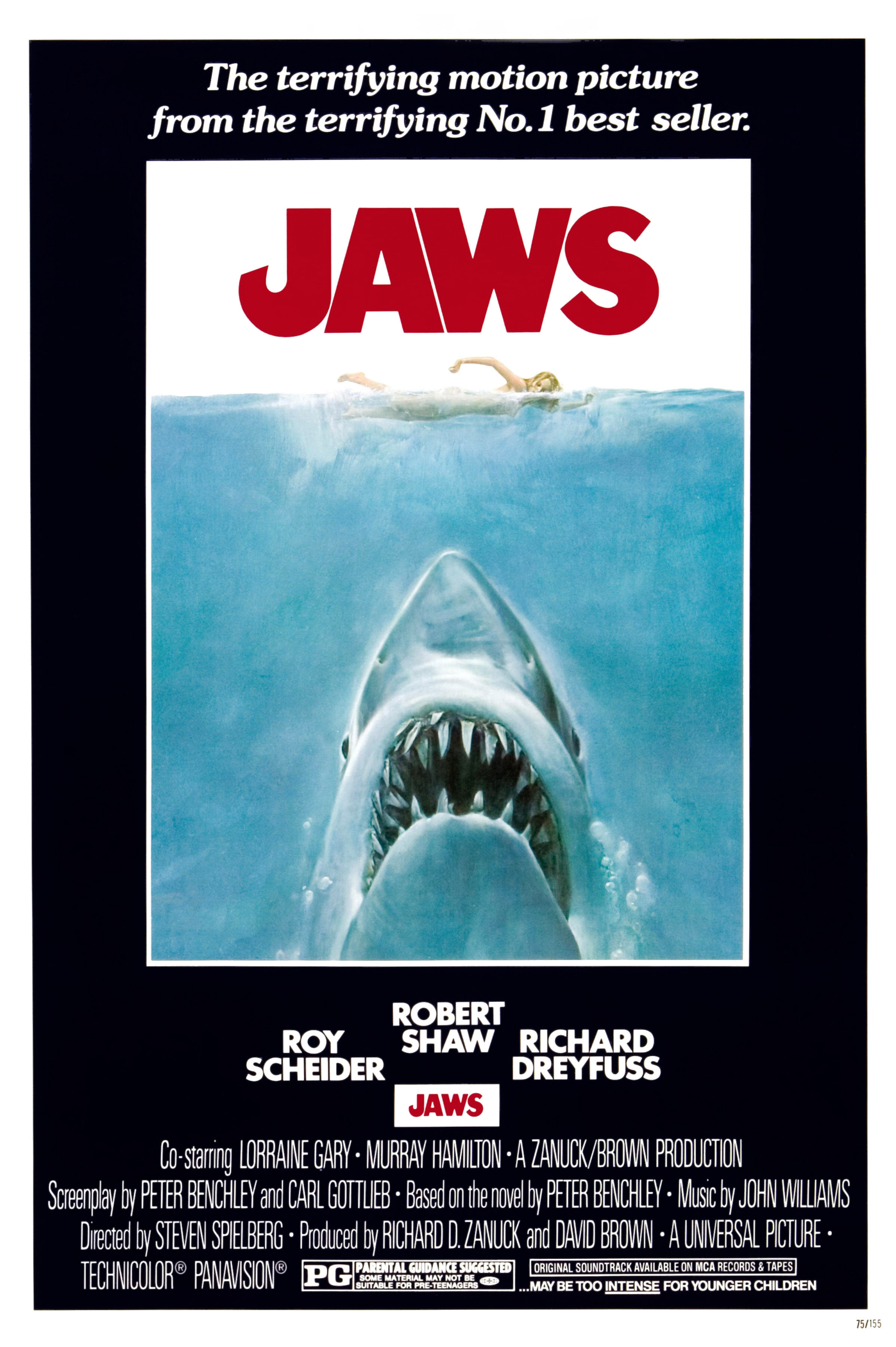
Fifty years later, “Jaws” still bites

It’s hard to believe that half a century has passed since “Jaws” was released in July of 1975.  I was in Palm Springs with my family when we went to see it at the Plaza theatre.  I took the paperback of the Peter Benchley novel with me so that I could finish it in our motel room before seeing the movie.  It remains one of the most memorable film experiences I’ve ever had.

Earlier this month I watched “Jaws” for the first time in many years along with my 21-year-old son who had never seen it.

In order to temper unrealistic expectations on his part regarding a 50-year-old film, I explained to him that “Jaws” was made 20 years before CGI came on to the scene.  Spielberg was one of the first directors to use CGI for 1994’s “Jurassic Park.”  Even then, he insisted on using practical effects with the dinosaurs and not rely solely on computers.

Smartly, Spielberg reveals little of the shark until the climax.  When it is finally shown as it breaches onto the boat swallowing Shaw’s Quint, the use of a mechanical puppet is frightening since he is actually interacting with a real object and not reacting to nothing but a green screen.My son came away impressed.

What elevates “Jaws” from other excellent movies is the impact its success had on the movie industry.

The summer blockbuster.  Before “Jaws,” studios did not release their best pictures during the summer due to many theatres not having air-conditioning.  Once “Jaws” opened to packed theatres, it became clear that people would stand in line for an “event” film no matter the weather.  “Jaws” earned $260 million domestically in its initial release.  Two years later, “Star Wars” would open Memorial Day weekend and surpass that mark, earning over $300 million.  Thus, the summer blockbuster was born.

Wide release.  Eschewing the common exhibition practice of opening a film in a small number of theatres, gradually expanding over several weeks, “Jaws” opened in over 400 theatres.  This greatly boosted its earnings at a faster clip (this was before multiplexes became commonplace).

Trailers on TV.  It was uncommon to advertise new movies on television.  Universal Studios aired commercials a few days before the release of “Jaws” thus generating high interest. 

Just as Alfred Hitchcock’s 1960 “Psycho” made people afraid to take showers, “Jaws” made people fearful of swimming in the ocean.

Additionally, “Jaws” catapulted the careers of Steven Spielberg, John Williams (who would go on and score the bulk of Spielberg’s canon), Roy Scheider, and Richard Dreyfuss.  Before “Jaws,” Robert Shaw had established himself as an in-demand character actor for a quarter of a century which explains why his name had the highest position in the credits.  Sadly, his career would be cut short, dying three years later at age 51from a heart attack.

Making “Jaws” took longer and cost more than expected.   Since much of the film was shot in Martha’s Vineyard off the coast of Massachusetts, the sea water damaged the 25-foot mechanical shark that was the film’s main prop leading to numerous delays.

The original 55 days of shooting tripled to 159, while the $3.5 million budget ballooned to $12 million.  A new documentary on the making of the movie depicts the stress that Spielberg was under, especially when hearing that studio bosses were thinking of shutting down the production.

Once filming finished, Spielberg had a full-blown panic attack.  He thought he would never work in Hollywood again.

Spielberg revealed that it took him years to overcome this anxiety, often having nightmares even after achieving great success.  To overcome his trauma, he would secretly board the Orca boat, part of the “Jaws” stop on the Universal Hollywood Studios tour, and lay down in the cabin to calm himself.

Clayton Kershaw, the Greatest Dodger Pitcher

Most baseball experts view Dodger legendary pitcher Sandy Koufax’s six-year run of outstanding dominance (1961-1966) as the best of any to ever play the game.  Unfortunately, Koufax had to retire at age 30 due to arm problems which limited his career numbers.

It could be argued that Clayton Kershaw is the greatest Dodger pitcher when it comes to longevity.

In his 18th season at age 37, Kershaw got his 3,000th strikeout on Wednesday to place him in an elite group of 20 pitchers who have reached that milestone.  No other Dodger is on that list.  It came on his 100th pitch of the night, the final out of the sixth inning.  That allowed a more extended time to celebrate Kershaw and his remarkable achievement with the fans and his family.  How magical was that!

It’s nice to know that Koufax has been Kershaw’s inspiration whenever Sandy visited spring training camps.  Kershaw was the one Dodger player to speak at the dedication ceremony of Koufax’s statue.  How nice a coincidence that both pitchers are lefties and have last names that start with ‘K’ which is shorthand for strikeout.

Kershaw won the Cy Young award three times in 2011, 2013, 2014, that last year also winning the MVP award.  Only 20 other pitchers in the history of the game have earned that honor.

Look at how Kershaw compares to others in the 3,000-strikeout club:

  • He is one of four left-handed pitchers on that list; Randy Johnson, Steve Carlton and CC Sabathia are the others.
  • He is one of three pitchers who stayed with the same team for their entire careers; Walter Johnson (Washington Senators) and Bob Gibson (St. Louis Cardinals) are the others.
  • He ranks fourth with the most strikeouts per nine innings.
  • He ranks second behind Walter Johnson (2.17) with the lowest career ERA of 2.52.
  • He ranks first with the highest winning percentage of .697 (216-94), meaning 70 percent of his decisions were victories.

What makes these achievements even more remarkable is the type of player and person Kershaw is:   

  • He’s a modest man who puts his team ahead of his individual feats.  To prove how true that is, last year when he was injured and hardly pitched, he was ecstatic about the Dodgers winning the World Series even though he admitted he had nothing to do with it. 
  • He leads by example.  His teammates marvel at his strict discipline in his preparation, adhering tightly to a timed routine that never varies which explains his consistency.
  • He is a competitor who pitches even better when there is traffic on the bases.
  • He is a decent person who never swears on the mound, a man of faith, who along with his wife Ellen has raised over $23 million assisting at-risk children and their families around the world with their Kershaw’s Challenge organization.

In his press conference after the game, he mentioned one pitcher in his time with whom he modeled himself after:  CC Sabathia.   Kershaw mentioned how Sabathia would often pitch on short rest and put his team on his shoulders during the playoffs.  Sounds like Kershaw and his competitive approach to the game.  No matter how many tough times he’s had in the playoffs, he’s the first one willing to push his body to its limits to help out his team.

I had a hard time deciding whether to attend Wednesday’s game. The big draw was the high chance that Kershaw would reach 3,000 strikeouts—he only needed three more. When you go to a game, there’s no guarantee your team will win or that you’ll witness something extraordinary like a no-hitter. But this felt like a near certainty. However, ticket prices had skyrocketed. In the end, my rational side won over my emotions, and I chose to watch the game on TV. That was a mistake.

That’s why when Kershaw is elected into the Baseball Hall of Fame five years after he retires, I will travel to Cooperstown to see that happen.   It’s the least I could do to pay my respects to a man who has given me so many wonderful moments as a Dodger fan.