Dodger Devotee

One of the benefits of being retired is to immerse oneself into hobbies.  One of mine is following the Los Angeles Dodgers.

I’ve been a Dodger fan all my life.  In fact, the Dodgers moved from Brooklyn to Los Angeles when I was born in 1958. One of the first memories I had was watching Don Drysdale pitch at Dodger Stadium in 1969, his last year of his career.

Back then, only road games from San Francisco and San Diego were televised so I’d listen to Vin Scully on the radio and keep score of the games. 

I followed the Dodgers as they won world championships in the 1960’s, 1980’s and now the 2020’s.

For the past few years, I’ve settled into a routine, immersing myself with all things Dodgers. On game day in the morning, I’ll read the sports articles in the Los Angeles Times including ones written by beat reporter Jack Harris, columnists Bill Plaschke, Dylan Hernandez and Bill Shaikin and editor Houston Mitchell. On The Athletic website, I’ll read any Dodger-related coverage.

At noon, I’ll turn on 570 KLAC, the Dodger radio station, and listen to Roggin and Rodney dissect the previous game and pontificate on that day’s game.

A couple of hours before game time, I’ll go to YouTube to find pressers with manager Dave Roberts.

I’ll turn on the Dodger TV station an hour before the game to watch John Hartung, Jerry Hairston and Nomar Garciaparra analyze what’s to come, then return to the postgame show with interviews from the players.

Then I go to the radio for Dodger Talk with David Vassegh where he takes calls from fans.

Finally, I watch the DodgerHeads podcast where a few hosts dissect the game for 90 minutes.

When the Dodgers are in the playoffs, as they have been for 13 consecutive years, I’ll turn on KLAC at 6:00 a.m. to hear host Tim Cates and former Dodger Steve Sax for the next three hours.

After each Dodger playoff game, Jack Harris and his fellow columnists upload a 15-minute video discussing that night’s action.

This year, the Dodgers are trying to become the first team in 25 years to repeat as champions, and the first Dodger team to ever win back-to-back World Series.

As of this publishing, the Dodgers have gone 7-1, winning both games in the Wild Card round against the Reds, three of four games in the Division round against the Phillies and the first two games in the Championship Series against the Brewers. 

They are six victories from reaching their goal.

Earlier this week, pitcher Black Snell pitched eight superb innings of shutout ball, allowing only one hit and no walks, striking out 10.  The next night Yoshinobu Yamamoto pitched a complete game.  After giving up a homerun on the very first pitch, he allowed just two more hits and one walk, striking out seven.

That was the first playoff complete game in eight years, 21 years since a Dodger pitcher had one by Jose Lima in 2004.  The L.A. Dodgers have had 23 postseason complete games, with Sandy Koufax pitched three alone in the 1965 World Series.

Both of my sons who are in their 20’s were amazed to witness something they had never seen before in their lifetime:  a complete playoff game by a Dodger pitcher.  One son told me, “Dad, it’s so weird to see a pitcher end a game and still be there shaking the catcher’s hand!”

Last year, the Dodgers’ bullpen catapulted them to a championship having only two good starters.  This year, the script has flipped.   Their bullpen is in shambles while their starting rotation has four ace-level pitchers.

Here’s how Times columnist Bill Shaikin describes it.

“In 16 games last October, the Dodgers had more bullpen games (four) than quality starts (two), and the starters posted a 5.25 earned-run average.  In eight games this October, the Dodgers have seven quality starts, and not coincidentally they are 7-1. The starters have posted a 1.54 ERA, the lowest of any team in National League history to play at least eight postseason games.

“The Dodgers have deployed four silencers. In dramatic lore they are known as famine, pestilence, destruction and death. These are only aliases. Their real names are Snell, Yamamoto, Glasnow and Ohtani.”

What a storybook ending it would be if future Hall of Fame pitcher Clayton Kershaw, the face of the Dodgers for the past 18 years, was put into the final inning of the last game of the World Series so he could experience the joy of hugging his catcher, last man standing on the mound.

I tell you one thing:  This team is on a mission.  Dodger fans can’t wait to see what they do next.
Clayton Kershaw, the Greatest Dodger Pitcher

Most baseball experts view Dodger legendary pitcher Sandy Koufax’s six-year run of outstanding dominance (1961-1966) as the best of any to ever play the game.  Unfortunately, Koufax had to retire at age 30 due to arm problems which limited his career numbers.

It could be argued that Clayton Kershaw is the greatest Dodger pitcher when it comes to longevity.

In his 18th season at age 37, Kershaw got his 3,000th strikeout on Wednesday to place him in an elite group of 20 pitchers who have reached that milestone.  No other Dodger is on that list.  It came on his 100th pitch of the night, the final out of the sixth inning.  That allowed a more extended time to celebrate Kershaw and his remarkable achievement with the fans and his family.  How magical was that!

It’s nice to know that Koufax has been Kershaw’s inspiration whenever Sandy visited spring training camps.  Kershaw was the one Dodger player to speak at the dedication ceremony of Koufax’s statue.  How nice a coincidence that both pitchers are lefties and have last names that start with ‘K’ which is shorthand for strikeout.

Kershaw won the Cy Young award three times in 2011, 2013, 2014, that last year also winning the MVP award.  Only 20 other pitchers in the history of the game have earned that honor.

Look at how Kershaw compares to others in the 3,000-strikeout club:

  • He is one of four left-handed pitchers on that list; Randy Johnson, Steve Carlton and CC Sabathia are the others.
  • He is one of three pitchers who stayed with the same team for their entire careers; Walter Johnson (Washington Senators) and Bob Gibson (St. Louis Cardinals) are the others.
  • He ranks fourth with the most strikeouts per nine innings.
  • He ranks second behind Walter Johnson (2.17) with the lowest career ERA of 2.52.
  • He ranks first with the highest winning percentage of .697 (216-94), meaning 70 percent of his decisions were victories.

What makes these achievements even more remarkable is the type of player and person Kershaw is:   

  • He’s a modest man who puts his team ahead of his individual feats.  To prove how true that is, last year when he was injured and hardly pitched, he was ecstatic about the Dodgers winning the World Series even though he admitted he had nothing to do with it. 
  • He leads by example.  His teammates marvel at his strict discipline in his preparation, adhering tightly to a timed routine that never varies which explains his consistency.
  • He is a competitor who pitches even better when there is traffic on the bases.
  • He is a decent person who never swears on the mound, a man of faith, who along with his wife Ellen has raised over $23 million assisting at-risk children and their families around the world with their Kershaw’s Challenge organization.

In his press conference after the game, he mentioned one pitcher in his time with whom he modeled himself after:  CC Sabathia.   Kershaw mentioned how Sabathia would often pitch on short rest and put his team on his shoulders during the playoffs.  Sounds like Kershaw and his competitive approach to the game.  No matter how many tough times he’s had in the playoffs, he’s the first one willing to push his body to its limits to help out his team.

I had a hard time deciding whether to attend Wednesday’s game. The big draw was the high chance that Kershaw would reach 3,000 strikeouts—he only needed three more. When you go to a game, there’s no guarantee your team will win or that you’ll witness something extraordinary like a no-hitter. But this felt like a near certainty. However, ticket prices had skyrocketed. In the end, my rational side won over my emotions, and I chose to watch the game on TV. That was a mistake.

That’s why when Kershaw is elected into the Baseball Hall of Fame five years after he retires, I will travel to Cooperstown to see that happen.   It’s the least I could do to pay my respects to a man who has given me so many wonderful moments as a Dodger fan.

Blue Heaven

Sports is a diversion and this year with the exhausting presidential political season, boy, do we all need a diversion.

I was born in the same year when the Brooklyn Dodgers moved to Los Angeles in 1958.  Maybe that connection is why they have always been my favorite sports team.

This week, the Dodgers won their 8th World Series championship against the New York Yankees in five games.

I was too young to appreciate the marvels of the 1959, 1963 and 1965 teams, but I vividly recall the 1981, 1988 and 2020 teams.

This year’s edition may be the most inspiring.   After suffering the most pitching injuries of any other team and losing all-stars Mookie Betts and Max Muncy for months, the Dodgers still managed to have the best record in baseball.  Yet when the playoffs began, they were not expected to win the World Series; they were perceived as the underdogs.

The fact that unlike recent years they had to play meaningful baseball up until the final days of the season to secure a division title kept them on their toes.  There was no time to let up on the gas pedal with the San Diego Padres breathing down their necks (end of the cliches).

At the start of the season, the Dodgers were this year’s overdogs.  With over $1 billion of new contracts last winter, the bulk of that owed to Shohei Ohtani, perhaps the greatest baseball player of all time due to his high achievement as both a batter and a pitcher, the Dodgers were expected to win the World Series before the very first “play ball.”

However, their five-man starting pitching rotation in March was decimated come September.  Only Yoshinobu Yamamoto, the second huge acquisition after Ohtani’s, survived the 162-game season though he missed half of it due to injury; the remaining four starters were lost to season-ending injuries. 

At the mid-summer trade deadline, they signed right-hander Jack Flaherty.  Former ace Walker Buehler took two years to recover from his second Tommy John surgery and pitched poorly throughout this season.  No one gave him a chance of making it onto the postseason roster, but the Dodgers had no one else.

This gave them only three starting pitchers going into the playoffs whereas all the other teams had at least four.  What got them through the injuries was their bullpen, the highest performing of any other team.  

The role of relief pitchers has increased significantly.  In 2024, pitchers threw 26 complete games, an all-time low.  Back in 1975, Oakland A’s pitcher Catfish Hunter threw 30 complete games on his own.  Nowadays, if a pitcher completes six out of the nine innings and allows three or less runs, it is labeled a “quality start.” 

For the Dodgers, their starters barely reached five innings over the course of the season meaning the relief pitchers pitched nearly half of the total innings played.  And that trend increased during the playoffs.  In fact, due to the lack of a fourth starter, they scheduled bullpen games where up to eight pitchers were used to complete one game.   That should not be sustainable, but somehow the Dodgers rode that strategy all the way to a championship.  The Most Valuable Player award should have gone to the entire bullpen.

As the Dodgers ascended each step on their climb up to the title—winning the division, beating the Padres in the division series and the New York Mets in the championship series—their clubhouse celebrations were revelatory.  Their raw comments to reporters unmasked a gutsiness and a love for one another, an intense bonding not seen in recent memory.  Chemistry alone can’t count for success, but matched with each athlete playing for each other, lifting their teammates to another level, it made them unbeatable.

One refreshing aspect to the Dodgers’ championship is that for a change the team with the best regular season in baseball won it all.  In the past 29 seasons, the team with the best record won the World Series only eight times.

Up until 1968, baseball had two leagues:  American and National.  The first-place team in each league faced off in the World Series.

From 1969-1993, a second playoff round was added by dividing each league into two divisions, west and east, which doubled the number of teams eligible for the postseason.

From 1994-2011, a third round (division series) was added by rearranging some teams into a third central division and adding a wild card team from each league resulting in eight teams making it to the postseason.  No longer did a team have to win four postseason games; now it’s 11.

Today, more wild cards teams have been added with 12 out of the 30 teams go into the postseason.  That is why in one respect this year’s Dodgers may very well be the best team they have ever had.  And that’s why if you are a Dodger fan, you should still be grinning.  And if you a sports fan, you should feel validated that once in a while, a sports team that is the best during the regular season does win the trophy.

Seeing these high paid athletes get choked up over a game with a small ball and a long bat, their emotions catching in their throats, underscores that money isn’t everything.  Sports reminds us that joy can be found in myriad ways.  It’s up to each person to go find it.

The Dodgers’ championship is my antidote to whoever wins the election.

Mr. Clutch, My Hero

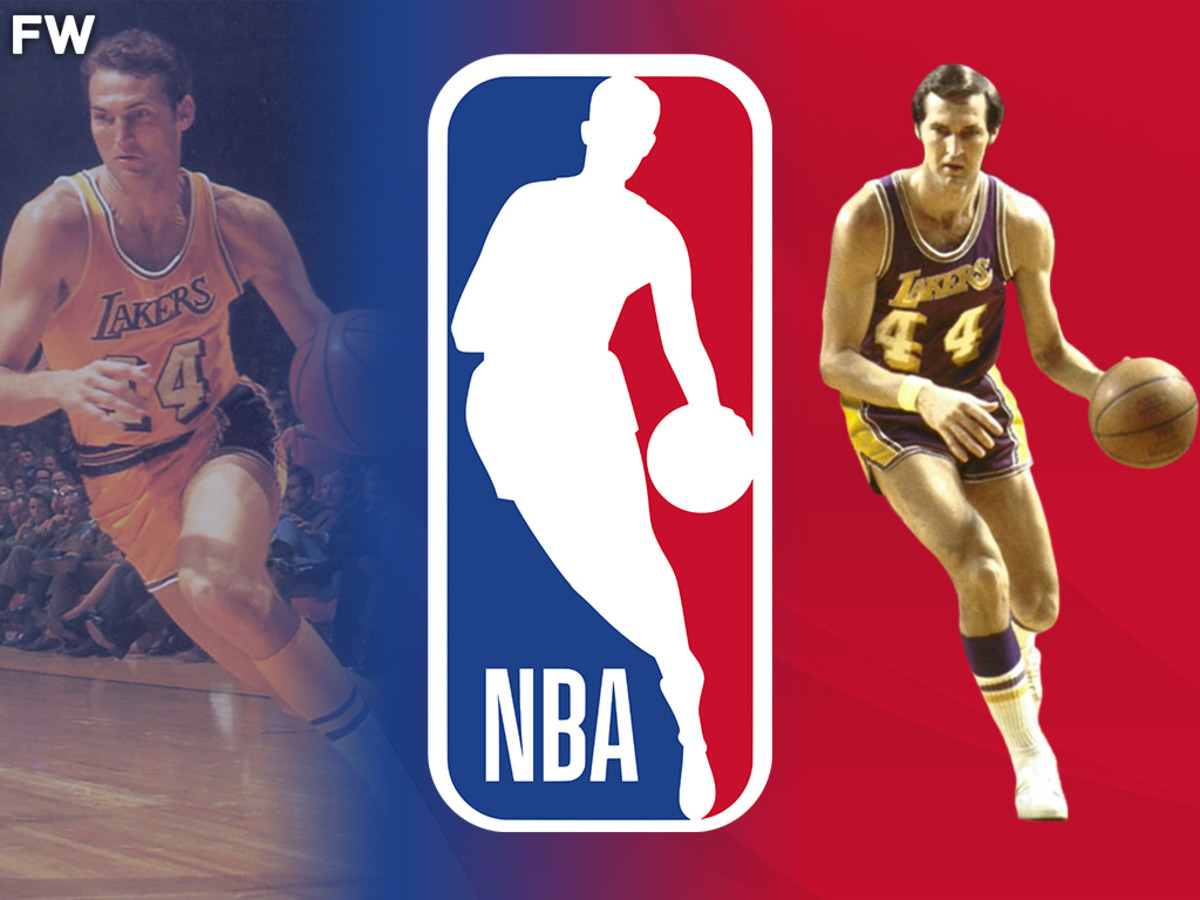
As a little boy, I had no aspirations of becoming a professional athlete.  I was short, overweight and had zero natural abilities.  But I had a basketball hoop attached to the backyard patio roofline where I shot 16-footers every day imagining I was Jerry West of the Los Angeles Lakers.

That’s why it was sad to hear the news that the NBA Hall of Famer had passed away at 86.

West along with Hall of Fame Dodger pitcher Sandy Koufax were my two biggest sports idols growing up.

Jerry West had a handful of nicknames including Mr. Clutch and The Logo.  The one I liked best was the lyrical Zeke from Cabin Creek making him seem mythical.

I respected his tenacity to want the ball every time he dribbled down the court, especially during playoff games.  In his 14-year career, he made almost have of his shots which is why I felt confident that whenever he had the ball in his hands the Lakers had a chance to win. 

He had his nose broken nine times.  Imagine having the courage to go through that and to continue playing at an intense level, unafraid of driving to the basket.

The one Achille’s heal was his inability to beat the Boston Celtics in the NBA Finals.  The Celtics beat the Lakers all six times they played each other with West on the team.  Even when the Lakers clearly had the superior team in 1969, something always happened which prevented the Lakers from claiming victory. 

Three of those contests went seven games:  only seven points separated the two teams in those deciding matches.

Laker fans felt the heartache of Jerry West who despite playoff heroics could not find a way to get the leprechaun off the Lakers’ backs.  In fact, he outplayed everyone in 1969 in points and assists, averaging 38 points per game making half of his shots, earning the MVP award, the only time a player on a losing team won it.  That did little to take away the sting from West’s psyche.

In his memoir, West described the depression he felt whenever the Lakers fell short of a title.  Even after his playing days were over and he became an award-winning basketball executive, West could not sit and watch his Lakers in playoff games.  He had to stand in a hallway away from the court, or drive around town in his car.  It’s funny that I used to do the same thing as a fan, unable to watch critical moments in a game, fearful that the Lakers would lose again.

Jerry finally won his one and only championship in 1972.  That team had the best record ever by an NBA team at the time of 69-13 which included a 33-game winning streak, the most consecutive wins by any team that still stands today.

When I was 13, I chronicled the streak by cutting out sports articles from the newspaper and taping them into a scrapbook.  

Earlier that same year, Sandy Koufax was voted into the Baseball Hall of Fame, a good year for my idols.

I was fortunate enough attend the game when the Lakers won that elusive NBA championship against the New York Knicks.

When tickets went on sale for the Finals, my sister Debra drove me to the Fabulous Forum in Inglewood.  After waiting in line for hours, we were able to get tickets for Game Five at the face value price of $15.  That wouldn’t even get you a beer at a game today.  Of course, we weren’t sure if there would be a Game Five at the time.

As it turned out, the Lakers were up three games to one when they returned home at LAX on May 6th to play for the championship at the Forum the next day. 

We were so excited that my sister drove us to LAX to see the players. For people younger than 50, what I’m about to tell you may seem shocking.  

Back then, professional athletes would de-plane at the same terminal as the general public and walk by themselves (no entourages) towards the carousel baggage claim area.  Security was scarce so my sister and I stood back watching the players wait around for their bags.  That was a perfect opportunity for me to ask for their autographs.

And then there he was, number 44, Jerry West, 20 yards away from me—and I froze.  I was too nervous to approach him for an autograph.

Instead, I settled for two of the five starters, starting forwards Happy Hairston and Jim McMillian, and back-up center Leroy Ellis.  I even got Hall of Fame announcer Chick Hearn’s signature as well.

When my brother, sister and I went to the game the next day.  Based on past experiences, we had no confidence that they could finally win a championship, but they did, beating the Knicks 114-100.  It was the only time I was at a sporting event that resulted in my team winning a trophy.

I feel fortunate that both of my boyhood sports heroes have lived long lives (Koufax will turn 89 later this year).  Though I never shook their hands or got autographs, it has been a warm feeling knowing that they were still around for most of my life.

A page from my scrapbook chronicling the 1971-72 Lakers.

My Blue Heaven

When was the last time you were at a book event?  You know, where the author talks about his new book, takes questions from the audience, then signs your copy, personalizing it for you?

It has been a while since I was last at one, but this month I’ve been to two; coincidentally both books are related to the Los Angeles Dodgers. 

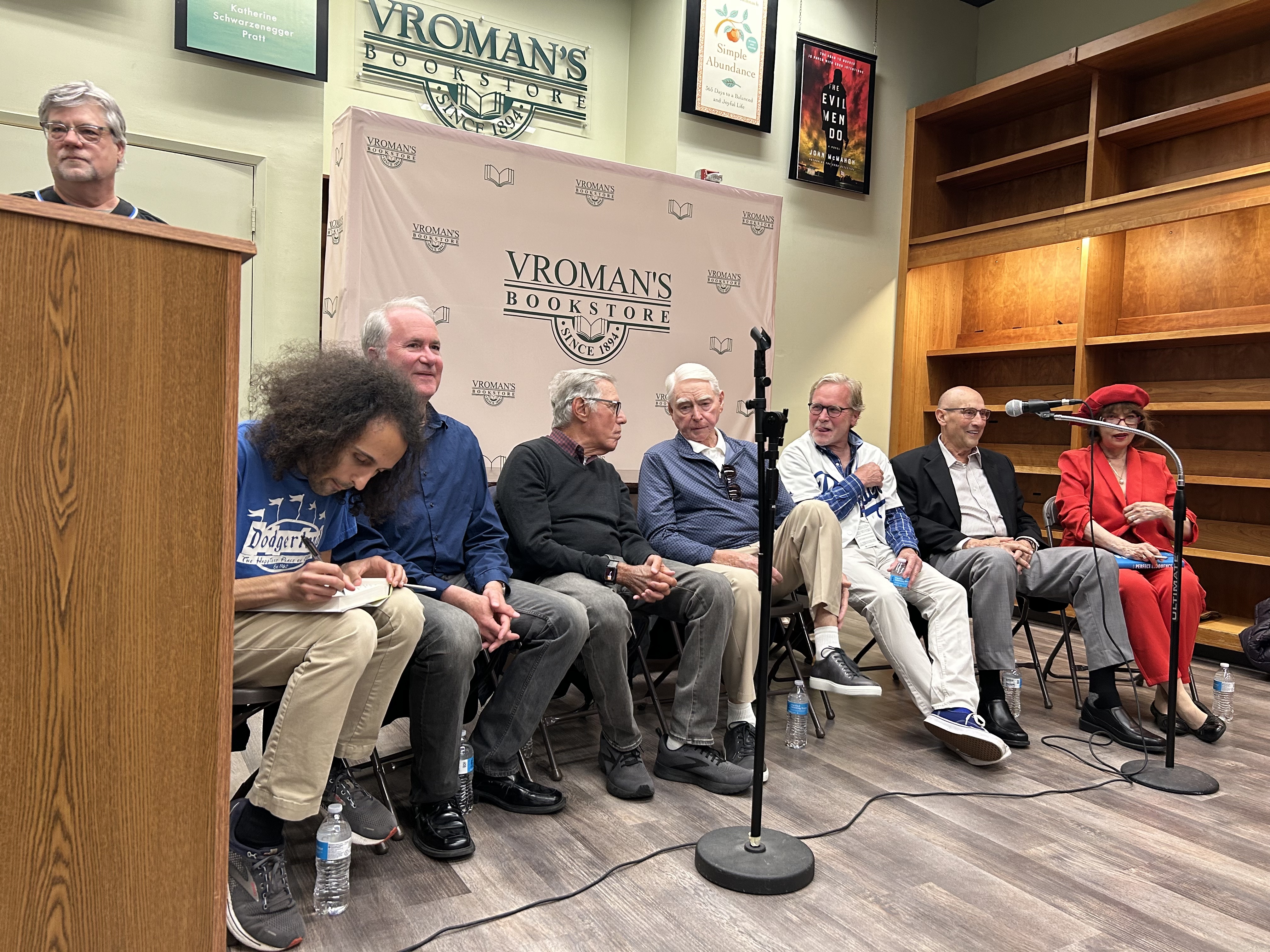
One book event was held at Vroman’s in Pasadena, an institution among independent bookstores since 1894; it is up for sale which makes its numerous loyal customers very nervous.

Perfect Eloquence:  An Appreciation of Vin Scully, edited by Tom Hoffarth, is a compendium of Vin Scully stories about the legendary Dodger announcer who passed away in 2022.

The physical book cover is printed in Dodger blue with an illustration of a microphone.

The top floor of the bookstore was overflowing with people.  This is the effect Vin Scully has on people two years after he passed away at age 94.

In addition to editor Hoffarth, seven other contributors were also in attendance:  journalists Chris Erskine, Paul Haddad, Pat Morrison, Ron Rapoport, Sammy Roth, and two very special guests, Hall of Fame announcer for the Los Angeles Kings Bob Miller and former Los Angeles Dodger executive Fred Claire.

Each one spoke about the piece they wrote for the book.  Each remembrance shared one thing in common:  that Vin Scully was the most generous man they every knew.  Notice that the focus is on the man, not the voice, which is how Vin Scully himself would have preferred to be remembered. 

Paul Haddad reminisced about the one time he met Vin Scully a couple of hours before a ballgame.  When he was escorted to the Press Box by a Dodger official, he saw Vin speaking into a microphone.  Haddad asked the official, “Is he recording commercials?”  The man responded, “No, he’s practicing.”  This story underscored how prepared Vin Scully was no matter how long he did the job, and he did the Dodger announcing job for 67 years.

The stories shared by Fred Claire were the most significant ones for he had a 50-year friendship with Vin.  He knew him better than anyone.

Fred Claire said that Vin had a perfect life in that he grasped the meaning of how to live one’s life:  being gracious to others.  He mentioned one time at Dodger Stadium a young reporter armed with a tape recorder came to interview Vin Scully before a ballgame.  The interview lasted 45 minutes.  Afterwards, Claire looked at the reporter who had tears in his eyes.  It turned out the tape recorder wasn’t working.  So Claire explained the situation to Vin, who said, “Tell the young man we’ll do the interview again.”

Claire spoke about how Vin and Jackie Robinson were very similar in their temperament.  At one of the last baseball events Jackie attended, when his vision was so diminished that lights had to be turned off whenever he was inside, a fan from the stands threw a baseball towards Robinson for him to sign, unaware about his poor eyesight.  Not seeing the ball, it bounced off his shoulder and hit his head.  People around him were yelling at security to throw the man out, but Jackie asked for the ball, signed it, and told people, “Return this to the gentleman.”

As Robinson famously said, “A life is not important except in the impact it has on other lives.”  In Jackie’s and Vin’s case, they were very important people indeed.

The second event took place at Stories Books and Cafe in Echo Park.  Andy McCullough, a senior writer at the Athletic, wrote The Last of His Kind:  Clayton Kershaw & The Burden of Greatness about future Hall of Famer pitcher Clayton Kershaw.  Andy was a beat writer for the Los Angeles Times covering the Dodgers which is how he knew Kershaw.  His former Times colleague, famed columnist Bill Plaschke, was the moderator.

What made the event extra special for me was that both McCullough and Plaschke visited my journalism classes.  When I did the high school newspaper, I would reach out to professional journalists to inspire my young students. 

When I mentioned this to both men that night, they did recall those outings.  Plaschke even remembered the name of a couple of my students who have remained in touch with him over the years.  I told him that I retired from teaching in 2020; he went up to me, shook my hand and said, “Bless you for what did.”

I happened to be the first person in line to have McCullough sign a book.  He didn’t have a pen, but I did and gave it to him.  After opening the book to locate a place to sign, he paused, puzzled and said, “I’ve never done this before, what do I write?”  That day was the release of the book so this was his very first signing event.

My initial thought was to tell him that I had two books published and had signings, but instead told him blandly, “Write ‘thanks for your interest’.”

If you’re a Dodger fan, you will have “interest” in having these two insightful new books published in the same month.  They will put you in Blue Heaven.

Editor Tom Hoffarth, contributors Sammy Roth, Paul Haddad, Ron Rapoport, Fred Claire, Chris Erskine, Bob Miller, Pat Morrison at Vroman’s Bookstore.

Author Andy McCullough and Moderator/Columnist Bill Plaschke at Stories Bookstore.