
During December, I enjoy re-watching old Christmas movies and TV shows because there is an emotional tether to my childhood.
One of my favorite is The Twilight Zone’s “Night of the Meek,” the only Christmas episode of the series. Starring Art Carney of The Honeymooners fame as an alcoholic department store Santa Claus, this was one of only a handful of episodes shot on videotape, so though it is in black and white, it doesn’t look six decades old; it has a “live” feel to it. The black and white cinematography and minimal sets adds realism.
But it is Carney’s conviction in the role as a troubled man who wants to do good for impoverished people that elevates the drama. The children and elderly men in bit parts come across as authentic.
Some of Serling’s lines that Carney delivers carry weight to the show’s theme of neglected children and the elderly.
After getting fired by his employer, he says the following speech.
“Christmas is more than barging down department store aisles and pushing people out of the way. Christmas is another thing, finer than that, richer, finer, truer. It should come with patience, and love, charity, compassion. . . . I live in a dirty rooming house and the street filled with hungry kids and shabby people where the only thing that comes down the chimney on Christmas Eve is more poverty.
“I just wish that on one Christmas, only one, that I could see some of the hopeless ones and the dreamless ones. Just on one Christmas, I’d like to see the meek inherent the earth. That’s why I drink, and that’s why I weep.”
This was powerful language for 1960 television. As he speaks, director Jack Smight intercuts close-ups of the children intently listening, including one Black boy, a rare casting decision at the time.
After departing the department store, Carney comes across a bag of gifts down an alleyway. He throws the bag over his shoulder and approaches children on the street and homeless men inside a Salvation Army chapel, asking each one what would they like for Christmas. Magically, he pulls out the very item requested from the bag.
At the end of the story, Carney has no more gifts. A friend observes that he didn’t get a gift himself.
“I can’t think of anything I want. What I really wanted is to be the biggest gift giver of all time. . . If I had my choice of any gift, any gift at all, I’d think I’d wish I could do this every year.”
Serling’s narration at the end:
“A word to the wise to all the children of the 20th century, whether their concern be pediatrics or geriatrics, whether they crawl on hands and knees and wear diapers or walk with a cane and comb their beards. There’s a wondrous magic to Christmas, and there’s a special power reserved for little people. In short, there’s nothing mightier than the meek, and a merry Christmas to each and all.”
It’s remarkable that this 25-minute show, shot over the course of a few days, withstands the test of time and can bring a tear 64 years later.
By the way, this episode was remade for the 1985 reboot of The Twilight Zone. Though 25 years separate the two versions, the 1960 original has more heart and actually does not look dated compared to the newer one.
What makes this show personal to me is that Serling, despite being Jewish like myself, wrote such a touching tale about the humanity of Christmas. I grew up loving a secular Christmas, believing in Santa Claus, and enjoying Christmas shows and music, many of which were created by Jewish artists.
P.S. Rod Serling was born on Christmas day, as was my father. Serling was only 50 when he died in 1975. He would have been 100 years old this Dec. 25th.
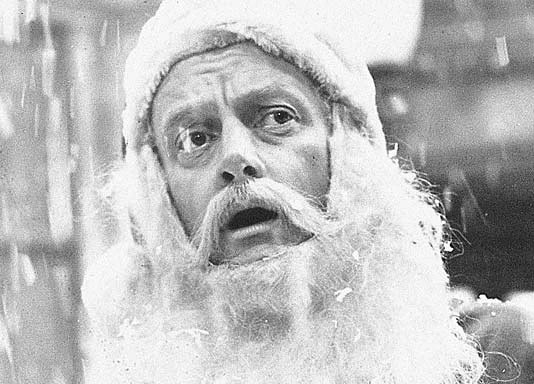
Art Carney as Santa Claus.

Writer Rod Serling, creator of The Twilight Zone.
 Crosby Chronicles