
As I went through my Sunday morning routine of making coffee and turning on the “CBS Sunday Morning” show, I watched a segment about people who rescued Jews during Nazi Germany. Varian Fry was one of those people, an American journalist working for the Emergency Rescue Committee that helped refugees escape from France during 1940–1941, including some artists such as Marc Chagall. On the screen flashed a montage of his art, and suddenly one caught my eye—a painting of a rabbi. It seemed so familiar.
Four days later over lunch with my sister, as is our practice, we each took out little pieces of paper with topics to talk about since our last get together. The first item on her list was the “CBS Sunday Morning” Chagall piece.
“Did you see that painting of a rabbi?” she asked me. Suddenly, I knew instantly why that piece stuck with me. “That’s like the painting Mom had hanging on the wall all those years.” While not the same painting, it was similar in its subject matter.
When I returned home, I took a photo of Mom’s painting, researched the image, and, bingo, discovered that it was by Marc Chagall! Titled “Rabbi with Torah” or “Rabbi met wetsrol,” the original is in the Stedelijk Museum in Amsterdam.
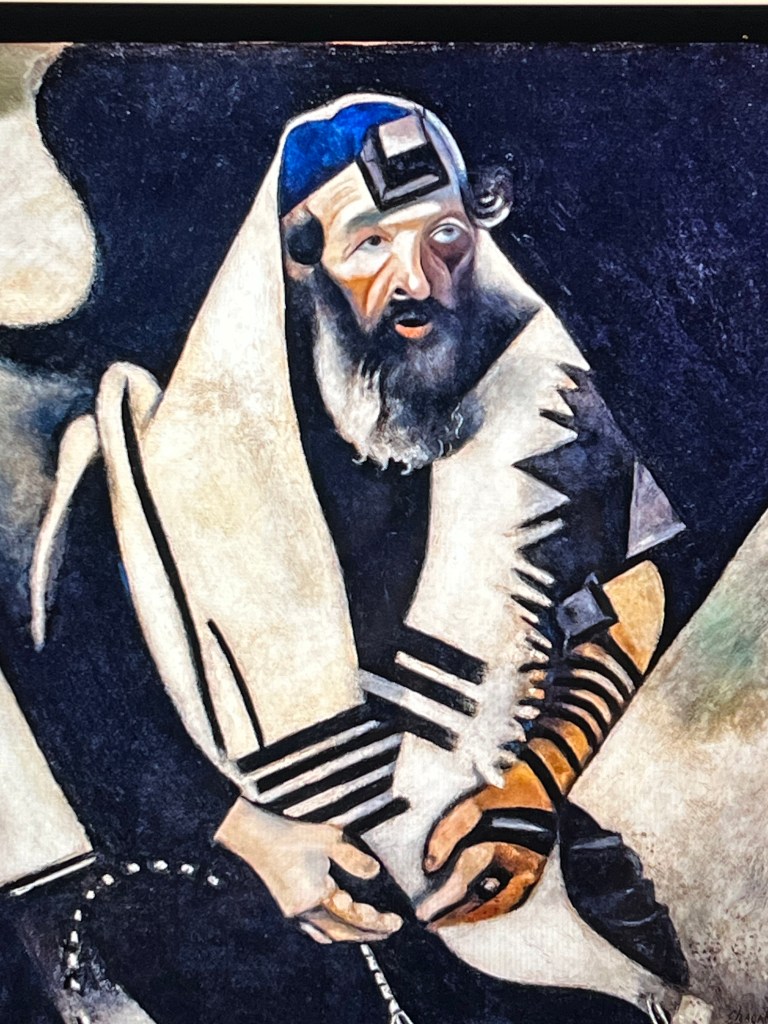
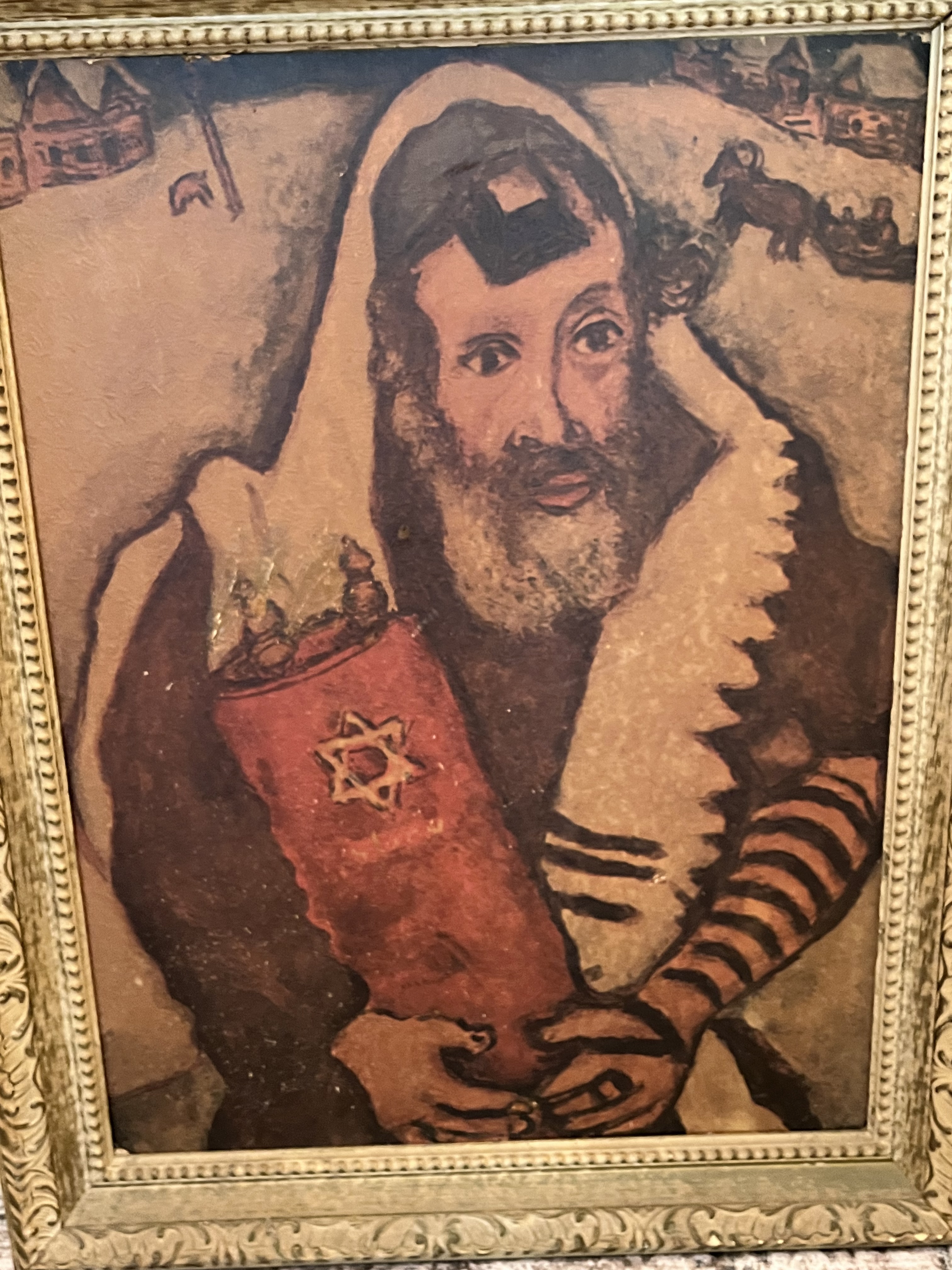
Two similar Marc Chagall paintings: “The Praying Jew” (left), “Rabbi with Torah” (right), my mother’s original print.
The painting Mom most admired, that she took with her from rental house to rental house, prominently displayed on a living room wall, turned out to be a famous work by a giant in the 20th century art world. I’m certain Mom never knew any of this; otherwise, she would have enjoyed regaling us with such joyous information.
Her eyes must have fixated on the Jewish-ness of the painting, a symbol of her heritage. None of us three kids remember our house without it.
My guess is she spotted this framed poster in a furniture store which back in the day would have inexpensive art for sale.
Another aspect of the painting which she didn’t realize was that the background depicted an aspect of her family history: a scene from a shtetl, a small village common in Ukraine in the late 19th and early 20th centuries.
Like Chagall, her parents were born in Ukraine’s shtetls. That connection would have meant so much to her.
Behind the rabbi figure, off in the distance, the ground is draped in snow, with a pig, a lamppost on the left, an adult and child on a sled pulled by a horse on the right, with a handful of small buildings on either side.
Oddly, we never bothered to talk to Mom about this piece, its presence so constant like a light fixture, there all the time but not thought about.
When Mom passed away 20 years ago, it was one of a few items that I took. Since the frame is dingy and the print faded and chipped (it never had glass), I didn’t consider displaying it in our house; instead, I secured it in the hall closet, with hanging jackets keeping it from tipping over.
Now, however, I had an urge to display it, most likely in our dining room where we had an empty wall as well as a special original charcoal drawing that was given to my wife’s great grandmother, who then gave it to her. What better place to hang my mother’s dearest picture, further establishing the dining room as a place for family history.
I brought the artwork to a professional framer who had done quality work for me in the past to see if there was any way to bring it back to life. The first question he asked upon laying eyes on it was, “Did either of your parents smoke?” The answer was “yes.” That was the main reason for the erosion of color in the print. Not having glass to protect it was a contributing factor. Using a Q-tip dipped with a solution of distilled water and Dawn dishwashing soap, he carefully touched a small portion of the poster. While it lightened the work a bit, it wouldn’t be sufficient for it to look presentable.
I made up my mind that if I hung my mother’s original, I had to get a new frame for it. Of course, there was another option—locate a better print.
With the excitement of this family treasure consuming me, I quickly set out to find a higher quality version online.
While price was a factor, my number one priority was finding a copy of “Rabbi with Torah” that looked as closely to the original painting. Of the half a dozen copies available, a few were poor reproductions; one was in worse condition than mine.
I settled on an eBay seller. The price and condition were fair plus it was already framed.
On Friday, Jan. 30, at 2:00 p.m. I bought it. I was so thrilled; I couldn’t stop thinking of how it would look on my dining room wall, and how I would surprise my sister and brother when they’d come over to see it.
The next morning, I received the following emails from eBay:
10:12 a.m. – “The seller marked your order as shipped!”
10:41 a.m. – “Your refund is on its way!”
Wait, what?! What did this mean, “refund”?
[To be continued.]
 Crosby Chronicles